





J7 Incident Analysis: King's Cross / Russell Square
King's Cross / Russell Square Incident Analysis
This article presents a detailed summary and analysis of the events reported as occurring around the King's Cross / Russell Square areas of the London Underground on 7th July 2005.
 |
Index of Sections
- The official version of events
- The first news reports
- The changing story
- Piccadilly Line train 311 or 331 or both
- Reported problems and closures on the London Underground
- The changing position of the explosion
- The carriage number
- The suicide-bomber theory gestates
- Eye-witness accounts
- Emergency service response
- Removal and identification of the victims
- The Casualty Bureau fiasco
- Images of the Piccadilly Line
- Germaine Lindsay identified
- A summary of unanswered questions, inconsistencies & anomalies
The official version of events
The official version of events at King's Cross - Russell Square suggests that Germaine Lindsay exploded a bomb on or close to the floor between the second and third set of seats in the first carriage of southbound Piccadilly Line train 331, between King's Cross and Russell Square, at 08.50 on July 7th 2005.
According to the Home Office's Report of the Official Account of the Bombings In London on 7th July 2005, the report that Tony Blair claimed would tell us “exactly what happened that day”:
08.23: The train arrives at King’s Cross, slightly late due to a delay further up the line. The 4 are captured on CCTV at 08.26am on the concourse close to the Thameslink platform and heading in the direction of the London Underground system. At around 08.30am, 4 men fitting their descriptions are seen hugging. They appear happy, even euphoric. They then split up. Khan must have gone to board a westbound Circle Line train, Tanweer an eastbound Circle Line train and Lindsay a southbound Piccadilly Line train.
08.50: On the Piccadilly Line, Jermaine Lindsay was in the first carriage as it travelled between King’s Cross and Russell Square. It is unlikely that he was seated. The train was crowded, with 127 people in the first carriage alone, which makes it difficult to position those involved.
Forensic evidence suggests the explosion occurred on or close to the floor of the standing area between the second and third set of seats. The explosion killed 27 people including Lindsay, and injured over 340.
Source: p5 Report of the Official Account of the Bombings in London
'Must have' and 'suggests' are hardly conclusive terms and there is no mention of sighting Lindsay on CCTV from the platform at King's Cross where the report claims that Lindsay boarded this train. Neither does the report mention any eye-witness sightings of Lindsay. The precise location of this explosion is also absent. What all four blast sites have in common is the statement that the explosion happens 'on or close to the floor'.
So, do we know 'exactly what happened that day'? According to our research, far from it.
The sequence of events according to the BBC timeline is as follows:
|
0940 British Transport Police say power surge incidents have occurred on the Underground at Aldgate, Edgware Road, King's Cross, Old Street and Russell Square stations.
1009 Witness Christina Lawrence, who was on a train leaving King's Cross, tells BBC News 24: "There was a loud bang in the tunnel and the train just stopped and all of a sudden it was filled with black, gassy smoke and we couldn't breathe."
1118 London's Metropolitan Police Commissioner Sir Ian Blair tells the BBC he knows of "about six explosions", one on a bus and the others related to Underground stations. He says he believes the six affected areas are Edgware Road, King's Cross, Liverpool Street, Russell Square, Aldgate East and Moorgate, but says it is "still a confusing situation". He advises Londoners to "stay where you are - all of London's transport is currently disabled" - he refuses to confirm any fatalities.
1215 The ambulance service says there are people still trapped at King's Cross station, and efforts are being made to rescue them.
1525 Police confirm that at [least] 33 people have been killed in the London blasts. At least seven were killed in an explosion on a tube train near Aldgate East station. At least another 21 were killed in an explosion on a tube train in the King's Cross/Russell Square area. Five have been confirmed killed in the Edgware Road station blast and there were fatalities on the bus attacked near Woburn Square, although how many is not yet known.
The first news reports
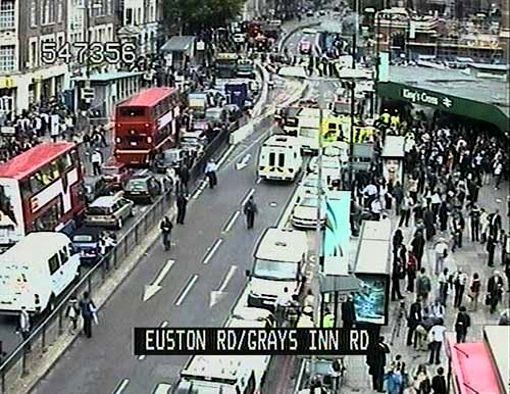
Despite TV news showing scenes from traffic cameras outside King's Cross with emergency vehicles parked up, no official mention is made of an explosion at King's Cross or Russell Square on TV news coverage until around 10.25, approximately an hour and a half after this explosion.
 |
Why the King's Cross – Russell Square blast is not mentioned for such a long time is unfathomable, given that the initial time line states that this was the second explosion timed at 8.56, just 6 minutes after the first reports of an explosion at Liverpool Street at 8.50, which TV News was covering from 9.17 onwards. BBC news had announced at 9.33 that there had been a second explosion at Edgware Road with no mention of King's Cross or Russell Square, the locations from which the majority of victims came -- double the number of victims than any other location affected on 7/7.
 |
Several sites shown on BBC graphics at 10.11 but still only reporting Liverpool Street / Aldgate and Edgware Road. |
The Metropolitan Police issue its first press release at 10.20:
Major Transport Incident [10.20]
Police are responding to reports from:
Edgware Rd
King's Cross
Liverpool St
Russell Sq
Aldgate East
Moorgate underground stations.Source: Metropolitan Police
|
ITN News first announce an explosion at King's Cross and Russell Square at 10.25, which is shortly after the MPS press release issued five minutes earlier at 10.20. This is also after the number 30 bus explosion has been announced and 90 minutes after 8.50, the time at which the Home Office report states all three underground explosions occurred. No explanation has ever been given for this delay.
These images below, taken from outside King's Cross at 9.25 - as shown by the clock at King's Cross - show emergency vehicles outside King's Cross station and traffic still moving along the Euston Road even though an explosion had apparently occurred some 35 minutes earlier.
| |
 |
Why there's such a long delay before this explosion is reported is even stranger considering that an incident on a train at King's Cross is described on the John Gaunt Radio Show, which broadcasts from 9.00am on BBC Radio London. During a live phone-in at around 9.34, Ian Wade, a BBC London employee on his way into work describes in detail to John Gaunt his experience of an explosion and of being evacuated from a train at King's Cross:
(Ian Wade sounds very callm, not at all traumatised, or as if he has witnessed anything horrendous) – 200m outside King's Cross – an almighty bang – lights went out – screaming - emergency electricity came on - they were walked to King's Cross after 15 minutes by an official – he asked one of the officials what happened and he 'thought one of the electric overhead lights fell down and hit the front of the train' – it was almost like a bomb going off - he thought the windows had come in but that wasn't the case - covered in soot though – in the dark for 15 minutes – the train was absolutely packed - asked by John Gaunt if he saw any injuries or damage to the train - not in the carriage he was on - he describes seeing just one injured passenger at King's Cross station with cuts on his arm - but that's the first and only one he's seen - just people covered in soot - he says he was told that one of the lights had fallen onto the front of the train - he even jokes at the end of the interview that he'll be late in to work!
Compare and contrast the above live account with the same Ian Wade recounting his experiences on the BBC website:
'I've never seen anything like it'
BBC London's Ian Wade was on his way to work when he witnessed horrifying images of mutilation after a bomb went off.
People with their clothes burned off, amputated limbs - those were the horrific images witnessed by Ian Wade who was caught up in the blasts as he travelled to work at BBC London in Marylebone.
Mr Wade was on an Underground carriage on the Piccadilly Line with his wife Evie when a bomb exploded in the carriage next to his around 0840 BST on Thursday.He said: "We had just got through King's Cross and I heard an almighty 'boom, boom' and the carriage stopped immediately. The electricity went completely and the carriage filled with soot.
"We could just make out what was in front but nothing else. The explosion was on the ceiling of the carriage in front and all the glass from the carriage had caved in. People were trying to kick the windows in.
Mr Wade added: "I could see there were people with their clothes burned off ... people with limbs missing.
"There must have been at least one death in there. I have never known anything like it."
He added: "My wife Evie really thought that we were going to die. It was just 'boom' and that was it. I couldn't think straight."
Mr Wade and his wife were inside the carriage for 15 minutes before they were able to get out.
"When the emergency services arrived, we all had to walk through the carriage in front to get out.
"Luckily there was a lot of straight thinking people on the Tube - there was only a few people who were losing it, screaming, but they were in the carriage where the blast happened, " said Mr Wade.
He praised the ambulance, police and London Underground for the way in which they dealt with the situation.
He said: "They kept checking we were okay then they led us to the Methodist Church nearby and gave us a cup of tea."
Mr Wade summed up his thoughts: "I don't know what to think. I've lived in London all my life and I've never experienced anything like this."
One can only wonder what was put into Mr Wade's tea for such a dramatic change in his accounts, the first given live, and the second posted on the BBC website a couple of days later. He is consistent in both his accounts that he was evacuated within 15 minutes, confirmed by his wife in her account which will be referred to later in this article. 15 minutes is very different to the accounts of other passengers from the second carriage who describe waiting at least 35 minutes before being evacuated and will be discussed later. Despite this live radio broadcast at 9.35, and the eyewitness account of Christina Lawrence at 10.09 which is referred to in the BBC time line, TV news media do not announce an explosion at either King's Cross or Russell Square for nearly another hour. Given that this transpired to be the incident with the highest number of casualties, the complete absence of any mention is curious to say the least.
Transport for London (TfL) fail to mention an explosion at King's Cross or Russell Square, reporting only explosions at Liverpool Street and Edgware Road in its first press release issued at 9.55 and it is not until 14.25 that this King's Cross is mentioned, with the train identified as travelling towards rather than away from King's Cross:
14:25 Transport for London Update
Latest information confirms that there were four incidents on London's transport network this morning, three on London Underground and one on London Buses.
At 09:46, the London Underground was suspended and all stations commenced evacuation following incidents at:
- Aldgate station heading towards Liverpool Street station on the Hammersmith & City line
- Russell Square station heading towards King's Cross station on the Piccadilly line
- Edgware Road station heading towards Paddington station on the Hammersmith & City line
The Piccadilly Line is run under a 30 year PPP (Public-Private Partnership) contract by Tube Lines a consortia made up of Amey and Bechtel and based at 15 Westferry Circus Canary Wharf. Morgan Stanley Dean Witter sublet the building to Tube Lines. They share the building leading to the video wall, built for use in stock trading but used as a Recovery Silver Control for the London Underground in the aftermath of the explosions. Information on the private companies that are involved in PPP contracts with TfL can be read on the J7 Liverpool Street / Aldgate Incident Analysis here. Tube Lines also reported that the train was travelling from Russell Square towards King's Cross in this press release issued on the day.
The Metropolitan Police issued another press release at 12.30 in which 4 sites were identified, as opposed to the original 6 sites, without any mention of which direction the train is travelling or on which line:
Latest news on London critical incident [12.30]
There are four confirmed sites where police are dealing with reported explosions this morning. These are:
1) Russell Square and King’s Cross underground
More details emerge, including 8.56 as the time of this explosion, in this MPS press release at 16.30 in which they claim there were two incidents at this site:
At 08.56 there was another incident at King’s Cross / Russell Square. Both stations were used to bring out casualties.
Walking wounded came up from the line at King’s Cross.
All those who were injured have now been treated, and at 12.30 the London Ambulance Service withdrew from Russell Square.
There are 21 confirmed fatalities and others with injuries from these two incidents.
The explosion on the Piccadilly Line was the most serious of the 4 reported explosions, resulting in 27 deaths and injuries to over 340 passengers. The train was described as being at 'crush capacity' which is approx 133 passengers per carriage, with slightly less in the first carriage due to the drivers cab, and 798 per 6-carriage train.
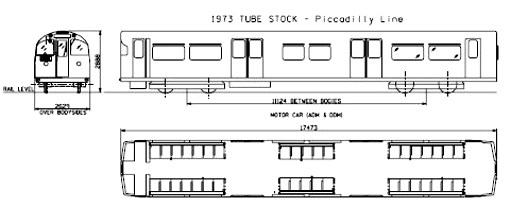 |
The first carriage of a Piccadilly Line train. Note that there are 2 sets of double doors and 1 single door on this carriage.
|
According to the Home Office report 'forensic evidence suggests the explosion occurred on or close to the floor of the standing area between the second and third set of seats', would indicate that this is in fact the standing area by the second set of double doors.
This incident was undoubtedly the most terrifying for passengers due to the Piccadilly Line between King's Cross and Russell Square running along a deep level single-track tunnel. This explosion is also more difficult to analyse as survivors emerged from both King's Cross and Russell Square.
The changing story
The first Home Office reported version carried by all the news media was of tube incidents staggered over the space of half an hour:
The first device exploded at 8.51am on a Circle line train between Aldgate East and Liverpool Street stations. Seven people were killed.
At 8.56am a second device exploded on a train between King's Cross and Russell Square, killing 21 people.
At 9.17am there was another blast on a train at Edgware Road station which blew a hole through a wall into another train on an adjoining platform. Two other trains were affected and seven people were killed.
Source: The Guardian, 8th July 2005
Not only will the timing of this explosion change from 8.56, but the train number and the position of the explosion on the carriage do as well. The timing isn't changed due to Trackernet images, as is the case with both Edgware Road and Liverpool Street, instead the precise time the Tunnel Telephone system was cut is used to determine the time of the explosion.
TfL issued the changed timing from 8.56 to 8.50, in a series of simultaneous explosions, on 9th July, stating the following reasoning:
TrackerNet is not yet live on the Piccadilly line between Hyde Park Corner and Arnos Grove. However, we can also confirm for the affected Piccadilly line train that the explosion occurred simultaneously at 08:50. Our evidence is based upon the precise time the Tunnel Telephone system on the Piccadilly line went out of service.
The Tunnel Telephone system is used to switch off traction current and can be switched off and on remotely, this doesn't mean that the driver has no means of communication, as train drivers have radio communication facilities. A handset can also be used to connect to the Tunnel Telephone system and speak to the Line Controller:
With the advent of train radio, the tunnel telephone wires are rarely used to switch off traction current these days. However, they do offer an alternative means of contact to the Line Controller in an emergency if there is a problem with the train radio. Traction current will be switched off when the handset is used but the Line Controller can soon arrange for it to be switched back on again and using the tunnel telephone wires in this way will usually mean less of a delay than trying to contact somebody by other available means.
Traction current can be turned off by train crews in the tunnel by pinching together the two bare copper wires seen at window level in all LU tunnels. A handset, provided on the train, can also be connected to these wires to allow the train crew to speak to the controller.
Source: Tubeprune
A log of events released by London Underground (LU) to the BBC shows the confusion surrounding the first moments. References to the Piccadilly Line blast in the LU Tube log are:
09:03: The Piccadilly line Duty Operations Manager receives reports of passengers running from King's Cross.
09:10: The Piccadilly line Duty Operations Manager reports to NCC a request for ambulances. In the twenty minutes that had passed since 08:50, the Network Control Centre was now dealing with four separate issues (power supply, derailment at Edgware Road / person under train, person under train at Liverpool Street, loss of high tension power cable near Moorgate) and was receiving the appropriate co-ordinated response from LU, emergency services and suppliers.
09:11: The Piccadilly line Duty Operations Manager reports loss of traction current in Russell Square both east and westbound and that a loud bang had been heard at Russell Square westbound with staff already investigating.
Source: BBC News
The Piccadilly Line Duty Operation Manager's report released to a J7 researcher under a Freedom of Information request states:
At 0850hrs, the tunnel telephone for Holloway Road – Russell Square westbound Current Rail Section tripped. The train service was held whilst station staff checked the tunnel telephones at relevant stations. Early indications were of a serious power failure, with loss of CCTV monitors in the central area. At 0856hrs, heavy smoke was seen issuing from the west bore of the eastbound platform tunnel at King's Cross.
Had the affected train left King's Cross by 08.50, when the tunnel telephone is reported to have tripped or was the line reset and then the train left the platform? According to Richard Barnes, chair of the GLA Review Committee who conducted the only formal public examination of some of the events of 7/7:
"The timelines have indicated that the bombs went off at 8.50am at Liverpool Street, 8.51am at Edgware Road, and 8.53am at King’s Cross."
Source: GLA 7 July Review Committee Final Report [PDF]
p9 Volume 2: Views and information from organisations
which would suggest that this is in fact what occurred, as the journey between King's Cross and Russell Square takes just 2 minutes and the train had travelled less than half that distance at the time of the explosion. If the Home Office report purports to tell us "exactly what happened" how can there be any discrepancy from any other source about the exact time at which the explosions underground occurred?
Piccadilly Line train 311 or 331 or both
On July 9th, Transport for London reported the following blast timings and locations, the direction of the train is now changed to travelling from King's Cross towards Russell Square:
London Underground, the Metropolitan Police and the British Transport Police can now confirm that the three bombs which exploded on three Tube trains on Thursday 7 July 2005 went off simultaneously at around 08.50.
Explosions were as follows (in succession):
* Circle line train number 204 heading eastbound from Liverpool Street station to Aldgate station.
* Circle line train number 216 travelling westbound heading from Edgware Road station to Paddington station.
* Piccadilly line train number 311 travelling from King's Cross St Pancras to Russell Square southbound.Source: Transport for London
Note the number of the Piccadilly Line train, 311. This was later changed -- without explanation -- to Piccadilly Line train 331, and an independent J7 researcher confirmed this via TfL's customer services:
19/Nov/2005
Thank you for your email dated 5 November.
I can confirm that the Piccadilly train involved on 7 July was the westbound train no 331. The initial reports that we received immediately at the time were incorrect and we updated our records accordingly as soon as we were advised.
Yours sincerely
Fola Olafare
Customer Service Centre
The notion is that Transport for London made a mistake when they originally reported that Piccadilly Line train 311 was involved in the events of July 7th. Somewhere along the line it appears that TfL corrected the original 311 announcement, although not via a published press release, and stated that it was Piccadilly Line train 331 on which the carnage occurred. The following is taken from the TUBE Professional's RUmour NEtwork, Tubeprune.
Update on 7/7 Attack for 10/7/05:
An update of the train identification is that the westbound Piccadilly Line train was actually 331 (not 311) running about 20 minutes late due to an earlier problem at Caledonian Road.
Source: Tubeprune
On 3rd January 2006, the story of Tom Nairn, the driver of train 311, and Ray Wright, his train operator passenger in the driver's cab of train 311 on July 7th, appeared in the comments on a July 7th related blog. The blog author has since chosen to delete this comment, although her response to the comment is still there. The train operator passenger in the cab of the affected train, Ray Wright, wrote this astonishing account of the driver of train 311:
Not wishing to denigrate any of the actions of police on the day, not ONE WORD has been said about the driver of Train 311, Tom Nairn. I joined Tom's train at King's Cross, travelling in the cab with him on my way to work as a fellow driver, based at Acton Town. I took the first couple of batches of walking wounded to Russell Square and was probably the first member of staff to meet any colleague at the station.
Tom stayed behind in the first car, doing what we as drivers are paid to do, looking after his train and his passengers on it. He helped some by applying tourniquets and reassuring others. He saw things that even trained police officers found themselves unable to cope with, but most importantly had to face it on his own before help arrived probably 40 minutes later, a scene of utter devastation in almost total darkness. He has never been mentioned or praised, he has remained dignified and quiet, and has never returned to drive a train.
Recently he applied for some compensation through his union. The response from the Met Police was "We have no knowledge of this person having been involved in this incident and therefore will not be processing his claim further."
Rather odd because Tom and I were interviewed by police for around three hours after the incident. The press coverage of the other 'heroes' has left him feeling completely empty and devalued. Pity when the reaction of Police and certain members of station staff are lauded he has been completely forgotten.
Ray Wright,
Train Operator,
Acton Town DepotSource: Blogger Comment
Tom Nairn, the driver of train 311 spent 40 minutes in almost total darkness dealing with the injured on his train, yet the Metropolitan Police had "no record of this individual being involved in this incident." If the MPS have 'no record' of Tom Nairn then whose name is on record as the driver of the affected train or did his name disappear when the train number was changed from 311, Tom's train, to 331?
Tom Nairn is not the only train driver that day who remains anonymous and ignored, none of the other train drivers of the affected trains have ever been honoured, named or even interviewed by the media. Other underground worker stories that confirm the Piccadilly Line train number as 311, include that of the Duty Manager at Russell Square tube station that morning, Gary Stevens:
GARY STEVENS, DUTY MANAGER AT RUSSELL SQUARE TUBE STATION
I was meant to start work at 0900 that morning. I woke up early, I couldn't sleep, so I decided to start work early. If I'd have gone in at the normal time I'd have been on the affected train, train 3/11, and I would have been in the first car. I use that carriage every day to exit the station...I was in my office at work, and at 0854 all the lights flickered in the office... we went down to the platform, couldn't see anything at all, when we noticed there was a light in the tunnel.
We hung on to see what it was and it was the driver of train 3/11 with about 30 or 40 injured customers, who had managed to get out and he led them down the tunnel. Some of them had quite serious head injuries, clothes blown off, things like that...
Source: BBC
The BBC choose to signify train 311 by using 3/11 in this report, almost as if they were drawing parallels with the American date notation for the Madrid train bombings of March 11th 2004.
One would expect that train drivers and station Duty Managers would know the trains they are driving or have passing through their stations, especially as - and confirmed by Clive D.W. Feather - the train numbers are used as radio call signs.
It would seem that Gary Stevens did not see train driver Tom Nairn, or the driver of train 331, but instead Ray Wright, a train operator who travelled in the cab of train 311 with driver Tom Nairn. Ray Wright initially handled the task of leading passengers to Russell Square while driver Tom Nairn stayed on his own for 40 minutes with his train to assist the survivors and injured. Interestingly Gary Stevens, quoted above, also claims: “I spent 40 minutes down there on my own before the fire brigade got there and it was the longest 40 minutes of my life, it seemed like four months.”
Despite Gary Stevens claim, the Fire Brigade never attended this incident from Russell Square at least not in the first hour and there are huge anomalies and inconsistencies in the accounts of which of the emergency services actually attended the scene or arrived first. More on that later.
This leaves us with a train driver, his Train Operator passenger in the cab that morning and the Duty Manager at Russell Square all telling us that the train in question was train 311. Furthermore both Gary Stevens and -- according to Ray Wright -- the train driver Tom Nairn, both remaining on their own for 40 minutes in a Piccadilly Line train.
The changing train number was once again checked by an independent public researcher to ensure that TfL were aware of the discrepancy between the two train numbers. Transport for London replied:
On Tue, 2006-01-17 at 19:16 +0000, Customer Services wrote:
Our ref: 1084546
17/Jan/2006
Thanks for your further email.
As stated in my previous email, the Piccadilly train involved on 7 July was the westbound train no 331. The initial reports that we received immediately at the time were incorrect and have now been subsequently updated.
Thank you for taking the time to contact us. Please get in touch if I can be of any further help.
Yours sincerely
Fola Olafare
Customer Service Centre
When an independent researcher, concerned that the times that the affected trains had left King's Cross were not to be found in any news report or on any official websites, managed to ascertain this information, the number of the Piccadilly Line train was absent altogether:
Subject: Re: train times on 7/7/05
Let me also apologise for the delay in responding to your query on the times of the trains that left King's Cross station on the morning of 7th July 2005.
I have been in touch with the British Transport Police and have managed to obtain the following information:
- the Eastbound Circle line train (204) left King's Cross at 08:35.
- the Westbound Circle line train (216) left King's Cross at 08:42
- the Piccadilly Line train south left King's Cross at 08:48
I trust the above is of use to you.
Vicky
Vicky Hutchinson
Transport Security Directorate
Department for Transport
Information from the Working Time Table released under a FOI request to a J7 researcher shows that train 331 was fresh out of Cockfosters depot on its first trip of the day and running approx 20 minutes late due to an earlier incident at Caledonian Road. Train 311 would be travelling north, (the direction given in the first TfL press release that mentions this incident), between Earl's Court and Hyde Park Corner at the revised time of 8.50 and would have arrived at King's Cross at 9.08. This makes it even more difficult to understand how this mix-up in the train numbers occurred.
Even the Piccadilly Line Duty Operation Manager's report, obtained under a FOI request by a J7 researcher, identifies the affected train as 311 rather than 331, and there is no mention of the position of train 331, the train that TFL now claims was involved on 7/7. Are we to assume that none of the people responsible for running the underground -- the driver of the train, his Train Operator passenger in the cab, the Russell Square duty operations manager, and Transport for London who issued a press release citing train 311 as the affected train -- actually knew which train they were dealing with at the time?
The following is taken from the Duty Operations Manager's report of 7th July 2005:
At 0850hrs, the tunnel telephone for Holloway Road – Russell Square westbound Current Rail Section tripped. The train service was held whilst station staff checked the tunnel telephones at relevant stations. Early indications were of a serious power failure, with loss of CCTV monitors in the central area. At 0856hrs, heavy smoke was seen issuing from the west bore of the eastbound platform tunnel at King's Cross. W311 was stalled between King's Cross and Russell Square, according to the signalling diagram, over the crossover leading from the eastbound to westbound running lines. It was mostly impossible from this point to gather information or make outgoing calls from Earl’s Court due to overloading of the telephone system. At 0900hrs, customers were seen exiting the westbound tunnel onto the platform at King's Cross. Traction Current was discharged from the Russell Square – Holloway Road Current Rail Section at 0900hrs. The Northern Line DOM was contacted and requested to stop train movements in the King's Cross area in case customers got lost and worked their way into the King's Cross loop. At 0908hrs, a report was received from the Russell Square supervisor that a loud bang had been heard on the westbound platform but that there was no damage or debris in the platform area. Efforts were made to hold trains in platforms but a number of trains became stalled in tunnels. These included E302 approaching Russell Square, E301 approaching Caledonian Road, E310 approaching Hyde Park Corner, E317 approaching North Ealing, E366 approaching Alperton and W334 approaching Holloway Road. All trains were worked forward under rule and detrained quickly, apart from W334 which was crush loaded. It was unable to proceed into Holloway Road due to the discharge of Traction Current ahead. The Arsenal station supervisor detrained W271 in his platform and travelled to W334. Many customers were transferred from W334 to W271 but it was impossible to transfer all customers to the assisting train. W271 was therefore worked back to Arsenal, arriving at 1032hrs. W334 was also worked back to Arsenal, arriving at 1049hrs. One customer was treated for the symptoms of a panic attack but no other issues were reported.
Staff at Russell Square quickly made their way to W311. They found that there had been an explosion in the first or second car. Their initial assessment indicated many casualties and a number of fatalities. At 0919hrs, a Code Amber message was sent by NCC, soon followed by a Code Red. Trains were gradually evacuated of their operators and planning began concerning the searching of all trains and provision, if required, of operators to move trains later in the day.
At 1132hrs, smoke was seen issuing from the roof vents of E255 at Barons Court. The station and local area were evacuated and BTP attended to investigate, arriving at 1226hrs. All clear given 13.55.
12.00 Last (Live) casualty removed from train at Russell Square
Source: Piccadilly Line Duty Operation Manager's Report, 7th July 2005
If train 331 is in fact the train that was stalled between King's Cross and Russell Square and not train 311, where was train 311?
Piccadilly line train number 311 becomes history and is replaced by train 331 with no explanation of how this error occurred in the original record of events or the accounts from train drivers, station managers or duty operation managers. The BBC graphic for this explosion still claims the train was number 311, and the GLA final report published on 5/05/06, also refers to this train as 311. The GLA final report differs from the official version on another fact in stating that this explosion happened at 8.53 and not 8.50. Who gave the GLA Review Committee this information regarding the train number and time?
2.1 first explosion on 7 July took place at 8.50 am on eastbound Circle Line train number 204, travelling from Liverpool Street to Aldgate station. Within one minute, a second explosion took place on a Circle Line train number 216, travelling westbound from Edgware Road to Paddington. A third bomb was detonated approximately two minutes later, on a southbound Piccadilly Line train number 311.
In response to a letter to a J7 researcher's MP, Tim O'Toole, Managing Director of TfL, allocates the train number error to the Piccadilly Line Duty Operations Manager:
"I can confirm that the number of the train involved in the Piccadilly Line terrorist bombing on 7th July was 331.
This has been confirmed by matching the unique carriage identification number with the train number allocated on the day within the train depot at Cockfosters. It has also been confirmed by the driver, his duty number and the reports of the station staff who initially attended following the explosion.
The source of the confusion appears to be the incident report of the Piccadilly Line Duty Operations Manager that wrongly quotes train 311 as the incident train.
I hope this clarifies the situation."
Contrary to Mr O'Toole's explanation, we have seen it was more than just the Piccadilly Line Duty Operations Manager that had 'incorrectly' identified this train and his claim that train number 331 was confirmed by both the driver and station staff, who had all previously claimed this train was 311, defies reason. The 'unique carriage identification number' is also another question mark that hangs over this incident, more later. A Freedom of Information request to TfL asking the position of the Piccadilly Line train 311 at 0850 on 7th July 2005 received a reply stating that it was at South Kensington, a stretch of the Piccadilly that would appear to be covered by the Trackernet control system although no Trackernet images have been released by TfL for the Piccadilly Line.
Perhaps there were two trains involved in this incident, whether these were 311 and 331, a notion which is supported by the many eye-witness accounts and reports from the scene.
Reported problems and closures on the London Underground
We know that there had been severe disruptions on the London Underground that morning, including:
At 06.25am a defective northbound train at Balham resulted in suspension of the Northern line in both directions between Stockwell and Morden. The problem with the train meant that there was a strong burning smell and smoke. The passengers were detrained, the defective train was checked and removed and the northbound service resumed at 09.05am. The London Fire Brigade was on site as a precaution in this instance, due to the nature of the defect however no passengers were reported injured.
At around 07.57 Caledonian Road station was closed due to a fire alert caused by a report of a strong burning smell coming from a defective eastbound train. The passengers were detrained (evacuated on to the platform) and Piccadilly line services were suspended between King's Cross and Arnos Grove until 08.28am.
At 08.51 six stations were closed because of a local power failure. The stations closed were Angel, Bank, Camden Town, Kentish Town, King's Cross and Old Street. This resulted in the suspension of the City branch of the Northern line. Following this all stations and train services were suspended after a general security alert across the network.
These disruptions led to commuters wondering if there was something up, as this account by a passenger on an earlier journey into London on the Piccadilly Line muses:
Did anyone travelling in BEFORE the attacks began yesterday notice anything peculiar on their tube journey?
I catch the Piccadilly line at 7.15am each morning from Southgate to reach my work in Kensington by 8.00. Normally, all seats are taken by Finsbury Park and carriages are packed by King's Cross.
However, yesterday my tube journey was eerily quiet. For the first time ever there were spare seats in my carriage all the way through zone 1. It was noticeable enough for me to wonder what on earth was going on. This was at 7.45 - over an hour before attacks began.
I've also heard people saying that the Northern Line was being shut down at the same time.
Is there something that we're not being told?
Reports of the closure of the southern end of the Northern Line between Morden and Stockwell are also described here:
I was due to pick a work colleague up from Balham at 7:15am, but when I got there I was greeted with Tube emergency vans, police and hoards of people being turned away from a closed station.
All very strange they must have known something was going to happen, they surely had a tip off. As I drove along the road, (which also follows the tubes) they were all shut and hundreds of people were queuing for buses.
When I reached Oval, which was open there were two armed policemen in a road next to the station, which for a quiet area like that is extremely rare.
The northern line was shut from Morden to Stockwell. They blatantly knew something was going down, they just got it wrong and are hoping no one mentions anything.
There were also problems on the Bakerloo Line:
Bakerloo line - suspended between Paddington and Elephant and Castle in both directions from 08:07 due to a defective train in Piccadilly Circus northbound platform. Services resumed with severe delays.
Along with various other problems on the Northern Line, including signalling problems at Old Street earlier that morning, there was a security alert at Bank station, both sites were identified in early reports as sites of explosions.
07.05 Bank – station closed due to security alert
Station closed and non-stopped due to an unattended bag on station. Station re-opened 07.27hrs. 22 minute delay.
Perhaps all these problems are just an ordinary day on the tube, but to some of the people quoted, including Emily, a passenger on this train, they do appear to foreshadow later events and appear to be at least some part of the reason for the failure of Government to hold a public inquiry:
‘I personally think the whole thing is suss - if you think about it there were apparent "power surges" all morning, I was even told there was a fire at Caledonian Road - (funny how on that same morning 4 bombs went off) - to me that whole morning was as though commuters were being put off travelling into London it was as though someone knew that something was going to happen on the underground - how funny we haven’t heard anything about the power surges since!!!!!!! No wonder they don’t want a public inquiry....’
Source: Emily, Piccadilly Line passenger
The changing position of the explosion
The initial account on both the MPS website and BBC state that the explosion happened by the first set of double doors on carriage one of Piccadilly Line train 311, (which was later changed by TfL to train 331). Even in their one week anniversary recap of the events the MPS repeat this information:
Piccadilly Line train travelling from King's Cross to Russell Square, approx 600 metres into the tunnel. The device was in the first carriage, in the standing area near the first set of double doors.
Source: Metropolitan Police Service
The BBC were also claiming the explosion happened near the first set of double doors:
 |
| |
BBC News web site reports Piccadilly Line Explosion by FIRST SET of double doors
|
Establishing the centre of an explosion is not a difficult task and it is makes no sense that this information was incorrect. The official version's account of the explosion on the Edgware Road train has been disputed by eye-witnesses and survivors from this train, and has led them to question the veracity of the report, only to be told by the Home Secretary, Dr John Reid in August 2006 that a final forensics report had not yet been completed.
J7 have submitted a FOI request to the Home Office to ascertain whether a final forensics report has been completed and if so, whether this has changed any of the information contained within the Home Office report as to the position of these explosions. The official report has already been discredited due to the incorrect statement it made that the 4 alleged 'bombers' caught a cancelled 7.40 train from Luton.
The BBC changed the graphic and the information on their website, whilst still claiming the train number was 311, whilst the MPS have never issued a correction or update:
 |
| |
BBC News changes their web site and reports Piccadilly Line Explosion by SECOND SET of double doors
|
The reason that the centre of the explosion was changed on the BBC web site from the FIRST SET of double doors on the first carriage to the SECOND SET of double doors would appear to be due to an eye-witness account of where she was standing at the time of the incident. The eye-witness maintains she was close to the FIRST set of double doors although, curiously, the same eye-witness has also stated that she was not aware a bomb had exploded in her carriage, or even on her train. Despite this, the eye-witness claimed the explosion could not have occurred at the location stated by the Metropolitan Police and news reports. The following account is taken from her BBC diary after hearing the news about where the blast location:
The rolling BBC and ITV news started saying the bomb at King's Cross was on the first carriage by the double doors going towards Russell Square - near where I had been standing.
When the blast went off I fell to the left into a heap of people, by the left-hand set of doors.
It was too dark to see what was smashed.
We escaped through the driver's cab and walked to Russell Square but the news said most people escaped out the back and walked to King's Cross.
When I started hearing the bomb was in my carriage, I flipped. I started pacing about.
I phoned the BBC to ask them where they got this information from, then I phoned the anti-terrorist hotline and gave a more detailed witness statement.
She then goes on to recount her interview with the anti-terrorist officers:
After a detailed anti-terrorism staff interview I found out some stuff I needed to share.
The King's Cross bomb was placed at the end of the first carriage, not the first set of doors on the front carriage as reported on the news.
The Tube tunnel was very narrow here and the train was very crowded, which was why most of the people were killed and hurt at the back of carriage one and front of carriage two.
Strange indeed that this was not just erroneous news reporting but information from official sources such as the Metropolitan Police and 'reputable' media organisations like the BBC, and that both official sources and the media were stating that the standing area by the first set of double doors was the site of the explosion. Whether any passengers were killed or badly injured in the front of carriage two is disputed by the evidence we have researched.
The eye-witness from the first carriage who hadn't been aware that a bomb had exploded in her carriage reinforces and supports Ray Wright's account that both both he and the train driver initially assessed that the explosion was due to a mechanical or electrical incident:
Tube driver tells of bomb chaos
A Tube relief driver who should have been sitting in the bombed King's Cross carriage has described the panic and disbelief during the rescue effort.
Ray Wright should have ridden near the suicide bomber in the front carriage, but it was so packed he sat in the front cab with his colleague.
"There was an explosion, the lights went, the cab door, we believe, blew in and smoke came in," he told BBC London.
"And the screaming, that's what we remember more than anything else."
Piccadilly Line driver Mr Wright would usually have been sitting in the carriage where Germaine Lindsay, 19, is believed to have carried out the most deadly of the four attacks on 7 July - killing himself and 26 others.
But he told how he sat up front with his colleague because the carriage was packed to capacity that morning.
"We call it crush conditions, you couldn't have got any more passengers on that train," he said.
"We got about a train and a half's length into the tunnel, everything seemed okay, when all of a sudden there was an almighty explosion and I remember everything happening at once."
Back in the passenger carriage, he described a "sea of blackened faces in a state of total panic."
"We were screaming, above the shouting, for everyone to calm down, that we were okay at the front and we were going to get people off."
He said as they got people off the train, he and the driver still thought it was a mechanical or electrical fault.
It was only when the first police arrived he was told other bombs had gone off on two other Tube trains and one on a bus.
While a local hotel brought blankets to the booking hall at Russell Square, Mr Wright watched as doctors tried to resuscitate passengers - "it was evident that there were limbs missing," he said.
"It's not something you anticipate seeing when you come into work, but I think by then the emergency services were there and they were in control.
"I think at the same point we were still standing in total disbelief that this was really happening.
The fact that two train drivers, after rescuing passengers from a carriage that we are told a bomb went off in, believe that this explosion was the result of an electrical or mechanical fault is consistent with many accounts from the other affected underground trains that morning. Ray Wright's description of the first police arriving and telling him that bombs had gone off on a bus could not have occurred until 9.47 at the very earliest. The initial cause identified for these explosions, power surges on the underground, are examined in detail here.
If the explosion did occur on train 331 at the rear of the first carriage why did Andy Hayman, CBE, Assistant Commissioner Specialist Operations, the officer in charge of anti-terrorist operations who was knighted in 2006, tell a press conference on 8th July 2005:
Probably the more complex scene of the four is the explosion on the underground train between King's Cross and Russell Square. The device was in the first carriage, in the standing area by the first set of double doors. I'll come back to that scene in a minute.
I've divided it up into a couple of categories. Firstly, it's the forensic opportunities that will be present in these four scenes. They are very challenging scenes. Our people are working under the most extreme circumstances. And when I describe the scene in Russell Square, it's yet to be the case for us to get near the carriage. There's the threat of the tunnel being unsafe and, of course, given the passage of time, we will be expecting things such as vermin and other dangerous substances to be in the air. And so those kind of challenges complicate what we need to now do.
Mr Hayman is reported as knowing 'instinctively' that these were explosions caused by bombs when he heard 'curious news reports of power surges'. News coverage of power surges were not broadcast until 9.16 at the earliest:
On Thursday July 7, Andy Hayman woke at 5am, travelled from home to central London and went for his daily run in St James's Park, a few streets from New Scotland Yard. A few hours later he was behind his desk on the fifth floor when he first heard that something was wrong. There were curious news reports of power surges affecting London's underground network.
Without having to be told, Mr Hayman, the assistant commissioner who is in overall charge of Scotland Yard's anti-terrorist operations, knew instinctively that this was the inevitable terrorist attack that the Metropolitan police had been preparing for and warning of since September 11, and now he would find out whether the force was up to the job.
"I thought we'd better start preparing for the worst," Mr Hayman said. "It's now come to fruition. Normality will never be the same."
An hour later, as he was being whisked to Whitehall for a meeting of Cobra - the government's crisis command committee - news came through that a bus had blown up, and the scale of the atrocity became clear.
Source: The Guardian
It appears that Hayman was not the only person with such prescient abilities, according to Hansard, at a forensics science conference that was taking place on July 7th:
Last summer, I journeyed to Lincoln to speak about the issue at a conference of forensic practitioners. The meeting took place on the day of the London bombings, and the people there knew immediately that it was not an electrical fault that caused the disastrous events that occurred one after the other. It was interesting that some of them disappeared because they had to help out with the analysis of the situation.
Even Tim O'Toole, Managing Director of London Underground could only claim:
"Following initial reports, we had one team concentrating on getting emergency resources to the sites and getting further reports, and we split another part of management to think about what we would be doing later, four hours and 24 hours later, because at that time of course, shortly after the bomb exploded on the bus we knew we were dealing with crime scenes."
This written submission from the Network Control Centre operator to the GLA Review Committee also confirms that the explosion on the bus acted almost as official confirmation of 'terrorist attacks'':
The next thing was a report of smoke coming from a Piccadilly Line tunnel at King’s Cross and this resulted in more calls to the emergency services. The power supply people at Leicester Square confirmed that they had lost one of their major supply routes and were preparing an alternative feed, thus it looked in part that things were similar to the major power failure 2 years’ ago (albeit now caused by a train severing HT cables and with more serious consequences).
The NCC, therefore, issued the “Network Power Failure” blanket message for trains to await traction current recharge, and it’s galling to see how in the media and on the internet the “power surge” theory is being described as an MI5 or Government cover-up put out to avoid panic. Although confirmation that these were terrorist acts had not yet been received, the Information Desk Operator and myself between us rung all London area Train Operating Companies (TOC) to explain the current LU-status and suggested to each TOC that they might wish to review their own security arrangements. Senior managers began arriving in the NCC and the ‘Gold Control’ function was established in an adjacent room.
Once the bus bombing had been confirmed it proved out worst fears, though by this time the evacuation of the entire system had already commenced. Buses were being withdrawn from Zone 1 and National Rail trains terminating short of the capital.
Source: GLA 7 July Review Committee Final Report p239 Volume 2 [PDF]
(Views and information from organisations)
The carriage number
As noted previously, all of the details regarding the original report of this explosion changed over time, this would also appear to include the carriage number of the affected carriage. Tim O'Toole claimed the train number was changed due to matching the unique carriage number allocated to each train. Which carriage number is not known for definite as there are at least three possible candidates.
The Piccadilly Line train, as advised by Clive Feather, consisted of the following vehicles:
"166-566-366-417-617-217, and the first carriage of that train - the carriage that was bombed - was carriage 166."
In an article about the first firefighters that arrived on the scene of the Piccadilly Line incident at 10.00, Blue Watch relive the bomb hell inside carriage 346A, carriage 346A is referred to eleven times, if you include the title of the article. In an Evening Standard article printed on 1/11/05, (only a cached copy exists), carriage 346A is again used to refer to the affected carriage of this train.
Yet carriage 346A does not feature in Clive Feather's train line-up.
From the blog of a J7 researcher:
The impossible carriage: Piccadilly Line 346A
A note on Piccadilly Line 1973 Tube Stock car numbering.
Each car has four axles labelled A, B, C, D. Each car has an A end and a D end. The couplings at the A end are different from the couplings at the D end. Cars can only couple A to D. Three cars couple to form a half train.For example, 146-546-346. 146 is the A car of the half train. 346 is the D car.
A full train would be: 146-546-346-4xx-6xx-2xx.
346 would be the third or fourth carriage from the front, depending on which way the train was going.
Which train does the physical set 166-566-366-417-617-217 belong to?
The Tubeprune informs me that:"Unit 166-566-366 was severly damaged, 366 is probably the only possible survivor but it has no other cars to work with at this time."
Since the explosion in 311 was near the rear of the first carriage and also damaged the second carriage, there is a strong presumption that 166 belonged to train 311, the train near Russell Square.
346A is impossible and 346D cannot be the first or second carriage.
Why are there two newspaper reports claiming that an explosion occurred in carriage 346A? J7 have submitted a FOI request to ascertain precisely which train the mythical carriage 346A belonged to:
Could you please supply the following information in regard to the events on the London Underground on July 7th 2005:
1. What were the numbers of all the carriages damaged on each train by these explosions
2. Have these carriages been repaired and put back in service
3. Which train and train number would have had a carriage 346A that morning. If it was not one of the affected trains I would still like this information
By 10th July, the time of the explosion, the direction of the train, the train number and the position of the centre of the explosion have all been changed from those originally reported. The one fact that doesn't change is that this explosion takes place on the floor of the train.
Update: A response from TfL was received in August 2007 with a list of all the affected carriages. The response also included a categorical statement that, "There is not a carriage 346A".
Our ref: 2516450
09/Aug/2007
Thank you for your information access request where you've asked for information about -
* The numbers of all the carriages damaged on each train by these explosions.
* whether there is a carriage 346A and if so which train and number would this carriage have belonged to on that morning, whether it was one of the affected trains or not.
Your request has been considered under the requirements of the Freedom of Information Act and I can confirm that we do hold the information you require.
On July 7 at 08:50 hours, three bombs exploded on three Tube trains as follows:
Circle line train number 204 (six carriages) heading eastbound from Liverpool Street station to Aldgate station;
Circle line train number 216 (six carriages) travelling westbound heading from Edgware Road station to Paddington station; and
Piccadilly line train number 331 (six carriages) travelling from King's Cross St Pancras to Russell Square westbound.
A fourth train, a Hammersmith and City line train sustained damage while passing train 216 at the time of the Edgware Road blast.
The carriages in which the bombs exploded (166, 6713 and 6505) have been scrapped and disposed of securely due to the damage caused.
A further 17 carriages were affected by the blasts at Aldgate, Edgware Road and King's Cross; the carriage numbers were 5558, 6558, 6523, 5523, 5505, 5593, 6593, 5713, 6548, 5548, 6732, 5732, 366, 566, 217, 417, and 617.
There is not a carriage 346A.
...
Yours sincerely
Fola Olafare
Performance Manager
Customer Service Centre
Additional information, and questions about how Channel 4 managed to make a 'documentary', The Miracle of Carriage 346, broadcast on the third anniversary of 7/7, can be found on the J7 blog.
The suicide-bomber theory gestates
The idea that these attacks were carried out by suicide-bombers was first suggested by journalists rather than the police. Furthermore, during the early stages of the investigation the police are at pains to make the point that as the explosions occurred on the floor of the trains there is no reason to assume that they were detonated manually. Andy Hayman at a Press Conference on 8th July 2005, said:
At this stage, we do believe, however, that each device that was put onto the tube trains was likely to be on the floor of the carriage.
Sir Ian Blair, the Commissioner of the Metropolitan police, was countering journalists who were posing the question of whether these were suicide-bombs, at the same press conference:
BLAIR: No, as I said earlier on, Ian, there is absolutely nothing to suggest this was a suicide bomb. There is nothing to suggest that. We can't rule it out. It may have been that. But it may also have been a bomb that was left on a seat. It may also be a bomb that went off in transit. These things are still open to the investigation. And I think the continuous reference to suicide bombing is unhelpful, because it's completely unproven.
QUESTION: Just following on from that, and I have a second question. But just following on that, is it the working assumption at the moment that those on the Tubes were devices which were left? They weren't with an individual when they went off, or can you not know?
BLAIR: I just don't think we can answer this question. As Andy has already said is it looks like the ones on the Tube were on the floor. So that may give you some idea, but that's ...
QUESTION: So, you have no clues as to whether they were in the control of individuals?
BLAIR: We do not at this stage, no.
The fact that the explosions all occurred on the floor of the trains within seconds of leaving stations, indicated they were detonated by timing devices rather than manually, a point being picked up by many newspapers as the suicide-bomber theory begins to wane:
Information which has come out since indicates that a group of terrorists, possibly no more than one for each of the four explosions, could have arrived at King's Cross Underground station and planted bombs on three trains heading away from the station. The police are not ruling out the possibility of a suicide mission, but their latest evidence is that in each case the device was placed on the floor of the train. That heightens the possibility that the bombers simply stepped off as the doors closed, and may have been back on the street when the bombs exploded within 50 seconds of each other.
Source: The Independent
Police believe that a team of at least four bombers using commercial high explosives with sophisticated timing devices mounted last week's attacks in London, and fear they might strike again.
The details are the first to emerge from the massive investigation into the attack. They are based on a detailed examination of the timings of the explosions and early forensic analysis of the four blast scenes.
Source: The Guardian
Police would not comment on claims by US officials that timers had been discovered.
The fact that all the blasts ripped apart trains and a bus that had travelled though a tight area of the city, around King's Cross, has also prompted speculation that a small cell - and possibly a lone bomber - may have been to blame.
A single terrorist would have been able to place bombs on both of the Circle line trains and, by doubling back or by alighting and walking to stations just a few hundred yards apart, place a third bomb on the Piccadilly line train. He or she could then have boarded the No 30 bus, where the final device exploded 56 minutes after the first tube blast.
Source: The Guardian
The Guardian article also notes: In the City, as elsewhere in London, people were waiting anxiously for more information so they could assess whether more carnage was possible. After the explosions battered the financial markets and sent sterling sliding against the dollar, an analyst at one London bank said: "It would make a difference if we knew for sure that these were suicide bombers, rather than an active cell on the loose." The money markets must have been reassured when these attacks were eventually blamed on suicide-bombers.
Examining the events in London on July 7th, it is worth posing the question: 'who really benefited from these attacks and especially the notion of suicide-bombers' as it certainly wasn't Islam or Muslims.
Precisely how Lindsay 'not seated' in a carriage at crush capacity manages to both put his rucksack onto the carriage floor and then detonate it is difficult to fathom. The scene at King's Cross, where Lindsay is alleged to have boarded this train, and the train itself as described by an eye-witness:
All King's Cross trains were running late. I let 2 overcrowded trains go before boarding one at 8.40am. I had arrived at Finsbury Park at 8.30am. Normally there is a train every minute, but they were coming every 3 or 4 minutes. Therefore you had three times as many people attempting to board the trains as normal. So after waiting ten minutes I gave up and got onto the overcrowded train at 8.40am. And stood by the pole in the centre by the first set of double doors.
More people heaved on at each stop. Arsenal, Holloway Road, Caledonian Road, the train was now completely rammed. At King's Cross the platform was 5 or 6 people deep. People surged onto the train. We could not believe that they were even trying to get on, but if you were at the front of a heaving platform you were pretty much shoved on by the crowd. Anyway, on they all squeezed. Including Germaine Lindsay.
And 30 seconds later he detonated his bomb.
Source: Urban 75
Anyone who has ever boarded a train this packed knows they will at best be squeezed up against the door and unlikely to be able to work their way through the other passengers, particularly Lindsay, described as 'a big, powerfully built man, not fat but muscular'. Yet this is what we are to believe Lindsay managed to do. He somehow then managed to place a large rucksack, which according to the Home Office report 'CCTV shows are large and full' onto the floor of the train and manually detonate it, presumably by bending down to reach into it and pull a cord. The method of detonation, which was initially thought to be by a timing device, rather than the mobile phones used to trigger the bombs in Madrid (which would not work in a deep tunnel such as the Piccadilly Line), has never been officially stated. The Home Office report, whilst not specifying either the type of explosive used nor the method of detonation, makes attempts to dismiss the notion that remote detonation was likely, whilst not explaining how the devices were detonated nor specifying if timing devices could have been used, preferring to make the case for self-detonating devices:
* There is no evidence at the bomb sites of remote detonation, nor of any material at the bomb factory which would suggest that they intended to construct remote detonators. The fact that Hussain seems to have bought a battery that morning may provide further indication that they were using self-detonating devices.
Source: p12, Official Home Office Report
Eye-Witness Accounts
Both the BBC and the eye-witness diary extract describe damage and casualties in the 2nd carriage of this train, yet two eye-witness accounts from passengers who were standing in the 2nd carriage next to the adjoining door with the 1st carriage, do not report serious casualties or damage in this carriage:
I'm very surprised that there were so many deaths claimed at the King's Cross explosion. I was standing at the front of the second carriage and apart from a couple of voices that were screaming and praying, there were no cries for help that indicated serious injury or even death. Especially as many as 21 or more as reported. People were in a state of shock but remained calm. Is there any information on how they died or how the explosion could have killed them?
Mandy Yu, London
A J7 researcher asked Steve Lovegrove a passenger in the 2nd carriage standing at the adjoining door to the 1st carriage, whether he saw injuries or damage in the 2nd carriage:
no, I was the only person injured in the 2nd carriage. The damage was concentrated in the rear third of the 1st carriage. This is all in my account even if it isn't clear. The 2nd carriage was damaged though as the end of it took the force of the blast coming from carriage 1.
I can't account for what anyone else saw, I can only say what I saw from my point of view. But again if you read my account you will know there was a body lying in the junction by the third carriage badly maimed by the train. So there was at least one fatality further back up the tunnel. This has been reported by other people so I can mention it.
Despite the tunnel being very narrow, the junction that Steve describes seeing a body in is the crossover tunnel which runs between the westbound and eastbound tracks, and through which many of the passengers from the middle carriages of the train evacuated back to the eastbound platform at King's Cross as can be seen in this image:
 |
Perhaps 'the body lying in the junction by the 3rd carriage' that Steve describes seeing was a passenger who had been thrown out of the 1st carriage? This seems unlikely as Steve describes 'lots of things happened at the same time, there was a massive 'metallic' bang behind me which sounded like we’d hit a train at top speed, we stopped instantly'. A similarly unaccountable sighting of a body, this time in front of the train as a policeman approaches from King's Cross:
They had been walking south along the track for about five minutes when they saw the torso of a man, with no legs or arms, lying on the track in front of the mangled train. "If you hadn't looked hard," Asquith says, "you might not have noticed it was a person at all."
Source: The Guardian
Bodies being seen some distance behind or in front of trains also occurs in accounts of the Edgware Road and Liverpool Street explosions.
Within 2 minutes of the explosion Steve vividly and powerfully paints a scene of silence and darkness from inside the 1st carriage:
People were asking anyone with a phone to try and get a signal, I got mine out, even though it was useless, it was 8.52. We were trying to calm everyone down, eventually our carriage went quiet. The carriages behind were panicking, the one in front was silent, our carriage was eerily calm. I couldn’t see anything through the carriage door which hit me, it was pitch black, it wasn't there any more. I peered in through the window, I thought it was just the blackness of the dark which meant I couldn’t see the full carriage, no, many of them were dead and dying only feet in front of me yet I couldn‘t see it. I could see a man standing against the left hand rear of carriage one, my friend Mark was shining his phone through the window, trying to talk to him and the few people we could see, he never answered, he never moved for half an hour. Either he was deafened by the blast, in shock or unconscious. We were asking if they were ok through the door, and if we could get out that way, no answer. They were deaf, unconscious, dead, or on their way to Russell Square on foot. Course I didn’t realise this, there was no reason for us to believe a bomb exploded the other side of that door ........ After about 10 minutes we had heard nothing and it was getting really hot down there .... The buzzer on the intercom would go off every few minutes and everyone would shout for silence, we would ask for silence from the first carriage, even though it was silent in there. But the speaker would only crackle, and no message came through. After every failed message, people panicked again. Every few minutes a woman’s screams would come from the first carriage, and people would try to calm her from our carriage. I will never forget them. There were heavy bangs coming from both ends of the train, I thought the tunnel was collapsing, people were actually breaking out of the train. .....Mark tried to force the door behind us open to get the people out, he told them to stand back so he could kick it through, but couldn’t, it was buckled and swollen in towards us and jammed shut, the top half was blown through and scattered on the floor. It was so dark it was impossible to see what was happening in there, I could see part of the roof hanging down, which prevented us going through the window. Mark was still talking to the people the other side of the door, holding a woman’s hand through the door and reassuring them. A massive rush of air came through the tunnel as another train was coming down the tunnel and someone screamed out that it would hit us, I waited for the crash, I considered grabbing a man next to me, but it just faded away, They must have been clearing the tunnel to get us out After about half an hour people started to move down from in front of us, as I got to the end of my carriage I looked back and 5 injured people walked out of the carriage behind (the front one), then nobody else. We walked down through our carriage, as I did the tube manager from King's Cross came past us, I walked into the 3rd carriage, the first doors and windows were broken as the train had hit and rubbed the tunnel wall. I got out the 3rd side doors of the 3rd carriage onto the track and down a side tunnel as we had stopped on a ‘Y’ junction........
I looked back at the train, it was forced against the wall, and the sides were scraped. I recall seeing a form on the floor, I later realized this was a dead body. .....I phoned my University tutor to let him know we had been in a crash and would be late. It was now 9.40, I had been trapped underground in the smoke for 35 minutes. I waited in the ticket room on the floor to go to hospital. I phoned home and let my parents know I was ok, and I had been in a train crash ....... Eventually I was led outside, I was one of the last who could walk to leave King's Cross, by this time it was about 10.15, outside King's Cross resembled some sort of war zone, no public, no traffic, endless screeching of sirens and police holding the traffic at all junctions onto the road. Here I saw one of the worst things, a man in a suit, his back covered in lumps of other peoples flesh and sheets of burnt skin, Only now did I realize how bad the situation was. I asked a cop what had happened and he said one word: “bombs”.Source: Steve Lovegrove
Why didn't Steve or Mark hear Ray Wright and Tom Nairn who ”.. were screaming, above the shouting, for everyone to calm down, that we were okay at the front and we were going to get people off". Why didn't he hear anything from Tom Nairn who 'stayed with his train and passengers for 40 minutes?' Or Gary Stevens who also claims to have stayed with the train for 40 minutes? How did Ian Wade (referred to earlier) and who claims to have travelled in the 2nd carriage, evacuate within 15 minutes, yet Steve claims he waits for at least 35?
Ian Wade's wife, Evelyn, gives a very different account of her experiences to the one recounted by her husband on the John Gaunt radio show, in an interview with the Independent although she also waited just 15 minutes to be rescued:
Evelyne Wade was in the carriage next to where she believed the bomb went off. Trembling and ashen-faced, she was amazed she had survived.
"We heard a big blast. The lights went out, and I thought I was going to die. Everyone was saying it was a fire and I thought we weren't going to get out alive," she said.
"We didn't move for 15 minutes and in that time, people were screaming, crying and banging on the windows, trying to get out. In the carriage next door, people were very injured and I saw a lot of blood on people."
Mrs Wade, 30, an estate agent from Oak Wood, said that when the train first juddered to a halt, she thought that it was just a continuation of delays that had already dogged her journey to work as an estate agent in Knightsbridge. But she soon realised it was more.
"We walked down the tunnel in the dark and there were a lot of injured people, and someone was dead. There was one big man who had lost all his clothes. There was someone else alive with no legs, we heard.
"There were lots of people in bandages and pads. We couldn't see very well because there was dust everywhere and people were panicking and covered in soot."
Were these accounts perhaps from a different train, the one heard by Steve Lovegrove: “... A massive rush of air came through the tunnel as another train was coming down the tunnel and someone screamed out that it would hit us, I waited for the crash ..” Or by BBC reporter Jacqui Head: “But then it sounded like another train had come up behind us and the carriage filled with smoke again and people became really, really frightened”. Or by Weaselbitch who blogged her account: “At one point it sounded like there was another train coming up behind us. There wasn’t, but I’ve still no idea what that noise actually was”.
Another explanation for the 'two-train numbers' and the evacuation within 15 minutes to King's Cross could possibly be a north-bound train:
8.45am King's Cross
As the northbound tube carrying Zeyned Basci approaches King's Cross there is a huge bang and shards of glass are sprayed on to passengers. "There was blood everywhere," she will remember later. "People were screaming and panicking. It was pitch black and then there was smoke. I thought I was going to burn alive." Through the smoke she sees a woman lying on the floor unconscious, her face gouged and bloody. A man is beside her, writhing with agony. There is light, somehow, from a torch, and as it scans the scene she gets flashes of the horror that is happening. Basci is covered in other people's blood. The carriage is filling with thick, black, choking smoke. It is hard to breathe. "Don't panic," says the driver, coming out of his cab into the carriage. But the passengers are not listening. They are screaming. The driver opens his own door and tells them to come through, and step down into the tunnel. The power in the tracks must have been switched off. There are hands in the gloom, helping men and women out and down. Basci is terrified. "I thought we were all going to die."
Source: The Independent
Another account of a passenger on a train pulling into King's Cross:
Another person to be caught in the drama was barrister's clerk, Chris Lowry, 17 from north London, was on [a] tube pulling into King's Cross when an explosion ripped through the station, killing 21 people.
He said: "I was reading my paper when I heard a bang. I don't know if I jumped up or fell forward, but I ended up out of my seat.
"All the lights were off except for one in the distance. Dust started to fill the carriage and I could barely see a thing. Everyone was calm in our carriage but further up I could hear women screaming and men shouting. As the dust thickened, I put my jacket in front of my face.
"I was terrified. I didn't know what was going on and had no idea if help was going to come. I checked my body to see if I was injured. I started to have a rising sense of panic. Someone walked through the carriage and said: "don't worry, there's not a fire, don't panic. We're going to get everyone out. They told us to pass the message on because they couldn't get far down the carriage. When we came out I realised just how serious this was. People had hair burnt off and had deep cuts. I got out of a door that had been taken off but some had to smash windows to get out. We were still in the tunnel when we got out. We had to walk on the tracks to the station. All the time we were being told not to worry.
"Once I'd got out of the train I realised how lucky I'd been there was blood everywhere. At the ticket machine at King's Cross people were lying around being treated by paramedics. There was blood everywhere."
Or perhaps like Hamish MacDonald who works for Channel 4 News, there is confusion over which train was actually affected, as his north-bound Northern Line train was evacuated before it reached the platform at King's Cross:
Our north-bound northern line train halted just outside of King Cross station after skipping the four previous stops. We were evacuated out of the drivers door, only to be met by hundreds of bloody, burnt and distraught passengers streaming off the Picadilly line train which had just been attacked.
The passengers we met, spoke of a loud blast, a flash of light and a smoke filled carriage. Most thought it was an electrical fault or a crash, but emerging from King's Cross station, where the drizzle had subsided momentarily, it became apparent that this was something more.
This eye-witness account talks of the derailment described by Steve Lovegrove:
At ten to nine, southbound on the Piccadilly line between King's Cross and Russell Square, my train was derailed. Obviously a derailment is rather scary but we hadn't heard anything about terrorism or anything like that at the time. There was a flash and a bang (not a big one, I doubt the train I was on was the one that took the direct hit of a bomb) and the train stopped surprisingly quickly. Smoke was everywhere so we were a little concerned about fire but it soon became clear that there was none so we just stayed put and waited for someone to tell us what to do! No one in my carriage panicked which is quite surprising as the smoke was really thick and nasty, everyone was breathing through shirts and tissues. We were stuck on the train for about 25 minutes before an official came and told us what was going on, and we evacuated quite calmly. I don't know what happened up at the front of the train though.
Alexander Chadwick from Enfield in London took this picture in the tunnel at King's Cross:
 |
Many of the casualties at both Edgware Road but especially Liverpool Street/Aldgate describe electrocution, as does Ian in his account of this blast:
Ian
I remember thinking that I've never been on such a packed train. The next thing I remember was reading a paper and then getting a sharp feeling of electrocution, like I imagine anyone who has been struck by lightning gets.I was knocked unconscious either during or after the electrocution and I maybe came round about 10 minutes afterwards.
Last week I had a go and I did the journey I did that day.
I went through the tunnel where it happened and to Russell Square where I lay injured for two or three hours waiting for an ambulance to arrive.
The one thing it's done is show the best of humanity and the worst of humanity on that day.
What springs to mind is not the worst of humanity because anyone who straps explosive to themselves to blow people up is a murderer.
Source: BBC News 16th October 2005
By October surely even Ian knows that Germaine Lindsay did not 'strap explosives to himself and blow himself up', although that is the accepted modus operandi of a 'suicide-bomber'. Gracia Hormigos also describes being 'electrocuted':
"We were only a few minutes out of King's Cross when this thing happened," said Gracia Hormigos, 58, a housekeeper from Tottenham, north London, who was on her way to work.
"My whole body was shaking. I felt like I was being electrocuted. The guy next to me lost his leg. I could see the bone. I was trying to help him, trying to keep him awake.
Richard South describes the explosion as resembling a 'loud power surge', John Sandy describes the train coming to a sudden halt and the explosion happening sometime after 09.00, whilst PC Bryan recalls his arrival at Russell Square:
"As soon as I got into the booking hall there were five or six people that had managed to get up into the booking hall that looked like they had been involved in an explosion. Their clothes were shredded. They all had blackened faces, hair standing on end and none of them knew that they had been involved in an explosion. A few people thought they had been electrocuted."
These survivors must be from the first carriage as these are the only ones to evacuate to Russell Square.
It is well worth noting that the majority of the injured from all three trains, apart from those that received wounds from flying glass and debris, mainly received injuries to their lower limbs, which indicates that whatever happened, actually happened on, at, or under the floor of the train.
Many eye-witness and survivor accounts from the 1st carriage also describe seeing a 'bright orange light' that George in his testimony to the GLA Review Committee describes here:
‘The Tube was moving. The doors were shut; we started to pull into the tunnel. It was approximately 12-15 seconds … This almighty bang. I said, “What the effing hell’s that?” In this millisecond, from the time that went, there was this bright, orange light opposite, and I’m facing the double doors, with my back to the doors on the platform side. In that millisecond, it went from a bright orange to nothing. What the hell was that? Of course, audibly I hear a lot – screaming, praying. We now know that 25 people around me were just outright killed; another 25 people were seriously injured. My first reaction was – I knew where I was in relation to the carriage, and I knew I was on the first carriage – I thought, “We have hit a train”. My first thought was, “We have hit a train; the driver is dead”. I can’t see anything. It’s pandemonium; there is black smoke pouring in and I’m having a hell of a job to breathe anyway. I’m thinking, in all these seconds, “This isn’t good. This isn’t good, because, if this is followed by fire, or more dense smoke, you’re not getting out of this, George”. I had literally written myself off; I felt this is where it ends. “You’re not getting out of this”. I couldn’t see. I had never experienced anything like that before. I can’t talk for other carriages but, in the first carriage, you could see nothing’.
George, survivor of the King’s Cross/Russell Square explosionSource: p31 GLA Final Report [PDF]
Not all passengers from the 1st carriage appear to have evacuated to Russell Square, as early accounts have Rob Raines being let out of the front carriage by the train driver and evacuating towards King's Cross within 15 minutes, the same length of time as Ian & Evelyn Wade have previously been quoted as stating they were on the train. Are these descriptions of different trains?
Rob Raimes was in the busy front carriage. "The lights suddenly went out and there was a crescendo of noise," he said. "Smoke had got in and was everywhere. My first instinct was that we had something on the track.
"We were in there for about 10 to 15 minutes until the driver let us out and we walked to the platform. It was a complete shock. One minute you are travelling to work as usual and then I thought I was going to die."
Mr Raimes, 44, a lawyer from Finsbury Park, north London, stayed for nearly two hours after he reached the platform at King's Cross, helping others who had escaped the blast.
"It was very distressing for me and I saw people who were badly injured. I didn't see any fatalities but I saw some who had lost part of their limbs and cut-glass injuries. There were quite a lot of people who helped, including passers-by."
There is little doubt that many passengers, such as Mr Raines, reacted with humanity and courage on the day.
Perhaps strangest of all are some of the interviews and photo-ops from Russell Square which appeared on TV and in the press. One particularly iconic image is that of 'grey-suit man' (name unknown), who is pictured lying on the ground in Brunswick Square some distance from Russell Square and is then seen being escorted back towards the station. This is filmed some 2 hours after the explosion, when surely a man with his injuries should at least be receiving treatment either in hospital or the triage centre that had been set up by staff from Great Ormond St Hospital.
 |
| 'Grey-suit man' being supported as he walks away from Russell Square station by the two men who pick him up in Brunswick Square and then escort him back up towards the station. |
| 'Grey-suit' man lying down and picked up in Brunswick Square. |
 |
| 'Grey-suit man' being escorted back up Bernard Street towards Russell Square Station at 11.12 |
These two ladies, again names unknown, are interviewed near Brunswick Square and then are asked by a policewoman to 'come back into the hotel now' at which point they too walk back towards Russell Square station. That the policewoman urged them to "come back to the hotel" suggests that that they were already in the hotel and that they had been allowed out for some reason, perhaps specifically to do interviews:
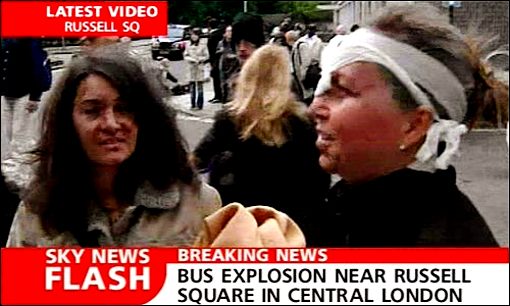 |
During this ITN interview with them in Brunswick Square they describe being in the first carriage they 'thought there was an explosion overhead' (which would be consistent with those who thought something had fallen on to the roof of the train and the image of the damage done to the carriage) and seeing the 'orange light' outside the train, but most astonishingly they claim to have waited just 3 to 4 minutes before being evacuated by the driver along the track to Russell Square; yet probably the most well known survivor of this incident and the most vociferous campaigner for an Inquiry into 7/7, who has yet to address the issue of the Inquiries Act 2005, claims in her BBC diary: “After about 20 to 30 minutes we started to leave the train.”
Click play below to watch this interview or see here for a longer clip:
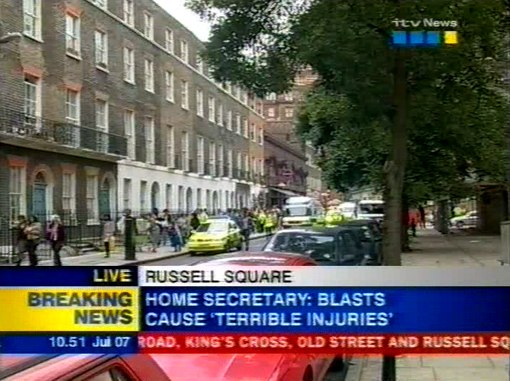 |
| The same two women walking away from Russell Square station down Bernard Street towards Brunswick Square |
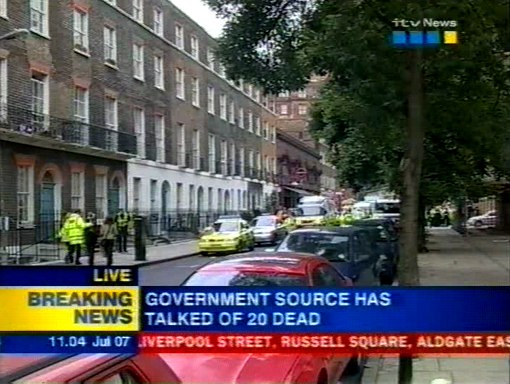 |
| The same two women after having been interviewed are then escorted back up Bernard Street towards Russell Square station, the scene of their trauma |
Could these have been some of the survivors that the BTP claimed were in their HQs in Tavistock Place by 9.09, described later in the emergency service response? Or could some of these 'casualties' and 'walking-wounded' be part of a live exercise, such as the Visor Consultant exercise that Peter Power was running and of which he said:
“at half-past nine this morning we were actually running an exercise for, er, over, a company of over a thousand people in London based on simultaneous bombs going off precisely at the railway stations where it happened this morning, so I still have the hairs on the back of my neck standing upright!”
Advice on conducting 'live' exercises suggests the inclusion of walking wounded and casualties to 'add to the realism', and is recommended to companies testing their emergency plans by the London Resilience website:
Live exercises. Live exercises range from a small scale test of one component of the response, like evacuation, through to a full scale test of the whole organisation to an incident. Live exercises provide the best means of confirming the satisfactory operation of emergency communications, and the use of 'casualties' can add to the realism. Live exercises provide the only means for fully testing the crucial arrangements for handling the media
The BBC web site even cites Roland Murphy of London Underground claiming of a similar rehearsal exercise at Bank station, "All participants are unaware of the 'disaster' until the exercise starts, so they treat it as real as possible."
Emergency exercise on Underground
Last Updated: Sunday, 12 June, 2005, 11:31 GMT 12:31 UK
London's emergency services are being called into action for a training exercise on the underground.The live emergency exercise will take place at Tower Hill Tube station on the District Line on Sunday.
The station is already closed due to major track replacement work between Whitechapel and Earl's Court.
Roland Murphy, from London Underground, said good safety procedures are in place "but we can always build and improve upon them."
He added: "All participants are unaware of the 'disaster' until the exercise starts, so they treat it as real as possible."
London Underground is legally required to hold an emergency exercise on the network every year.
A police cordon will be erected around the station and Trinity Square, Savage Gardens, Wakefield Gardens and Coopers Row will be closed for most of the day
Source: BBC News
In a BBC News report following the exercise Linda Smith of the Fire Brigades Union told BBC London of the controlled conditions under which the exercise was carried out:
"The cadets used as victims had been fully briefed and of course ordinary members of the public wouldn't have known what was going on, " she said.
"It was done on a Sunday, the area was cordoned off, there were no members of the public allowed even on the footpaths around the area.
Source: BBC News
Were some of the 'torsos' seen around the trains and these casualties reportedly seen in the King's Cross area actually from the sites themselves or perhaps 'dummies' used as part a live terror rehearsal exercise?
Piano removal man Rob Deller, 26, was working in Argyle Street, close to King’s Cross station. He said:
"We saw four burned bodies pulled out onto the street near the post office. They were lined up on the pavement and then put in an ambulance. One woman’s body was covered in a red blanket but you could still see her face. I thought that wasn’t very dignified and couldn’t believe they just left her face for all to see."
Besides the Visor Consultants exercise that day, another curious coincidence is that of a meeting of senior Network Rail staff at the Russell Hotel, just adjoining Russell Square tube station:
There was also at the time a meeting of senior Network Rail staff in the Russell Hotel, yards from the Tavistock Square and Russell Square tube station, and, donning their emergency jackets, they were quickly able to help out at the two nearby scenes of bombings, King’s Cross and Tavistock Square.
Source: Christian Wolmar
Even more coincidentally, the London Ambulance Service were meeting at their headquarters to discuss a previously held simulation of "four terrorist bombs going off at once across London." Some coincidence of events indeed:
9.10
Today it is the turn of Julia Dent, chief executive of the South West Strategic Health Authority, to be "gold lead", the person in charge of the response of the National Health Service to any major disaster. By an extraordinary coincidence, all the experts who formulate such plans are together in a meeting at the headquarters of the London Ambulance Service - and they are discussing an exercise they ran three months ago that involved simulating four terrorist bombs going off at once across London.Source: The Independent
There is also the possibility that Benjamin Netanyahu, who was staying in a Bloomsbury Hotel, possibly the Russell Hotel next door to Russell Square station, and who was warned in advance not to leave his hotel to travel to another site of an explosion, would be a more likely target of a politically motivated 'terrorist attack' rather than innocent civilians on the tube. That Netanyahu or the Tel Aviv stock exchange conference were the real targets of these attacks was dismissed by Israeli officials. Another Israeli link in the Russell Square area is referred to by ex-Mossad chief Efram Halevi, appointed to the board of UK risk management company Quest in March 2005, a company whose Chairman is Sir John Stevens, in his chilling article published on July 7th 2005 'Rules of Conflict for a World War':
One historical irony: I doubt whether the planners knew that one of the target areas, that in Russell Square, was within a stone's throw of a building that served as the first headquarters of the World Zionist Organization that preceded the State of Israel.
It was at 77 Great Russell Street that Dr. Chaim Weizmann, a renowned chemist, presided over the effort that culminated in the issuing of the Balfour Declaration, the first international recognition of the right of the Jewish people to a national home in what was then still a part of the Ottoman Empire.
Another hotel very close to Russell Square which may have had Netanyahu as a guest is the Imperial Hotel in Bloomsbury where the first draft of the Balfour Agreement was written on July 17th 1917.
Emergency Service Response
 Amongst some of the extraordinary stories of the day are those that tell of more than just cock-up and confusion, as this account from the Fire Brigade stationed at Euston a couple of minutes from both Russell Square and King's Cross shows:
For others responding to the explosions, though, the confusion persisted much longer. At Euston fire station, the call came through at the most awkward time possible: 9.01, a minute after the nationwide shift change from Wednesday's overnight Red Watch to Thursday's daytime Blue Watch. Euston station is only a third of a mile down Euston Road from King's Cross, but the first call sent them in exactly the wrong direction. Responding to a report of "smoke issuing at Euston Square," two engines sped south-west, away from King's Cross, arriving at Euston Square station to find underground staff closing it up. There was no smoke. "We were in a bit of a blind spot," says one firefighter who was involved. (The London Fire Brigade would not facilitate access to its frontline staff for this article, and firefighters said they feared disciplinary action if they were identified in the press.)
The crews returned to the fire station. Minutes later, they were summoned to Euston Square again, this time to respond to "a fire". They arrived to discover other engines parked up and awaiting further instructions. "A lot of people were coming up the road, saying there'd been a big bang on the tube," the firefighter recalls. "We'd heard of an incident at Aldgate, but we weren't sure whether this was part of that." While they were waiting, the bus bomb went off. Finally, the Euston crews were ordered to King's Cross, arriving shortly before 10 o'clock, to find other firefighters already coordinating the rescue effort.
Source: The Guardian - Attack on London
Another anomaly and not referred to by the GLA in their final report is this account by Andy Trotter, Deputy Chief Constable, British Transport Police:
'I was in the British Transport Police HQ in Tavistock Square when the first information came through at 9am. I immediately dispatched senior officers to the scene, then watched, horrified, as the tale unfolded in front of us.
'Within minutes, the casualties from Russell Square tube began arriving at our HQ. When the bus exploded, the whole building started rocking and debris began falling all around us. My first thought was to put extra security on our front door because the terrorists could try to gain access to the building by coming in with the injured. My children began texting me but I couldn't make a personal call to my wife until late afternoon: I didn't have a second to spare.'
Source: The Guardian
Through an FOI request to the BTP, J7 were informed that the casualties were brought to the BTP HQ from Russell Square due to the cordons that were erected in the area. This seems very unlikely, given the long delay in emergency services arriving at Russell Square and the fact that the underground was not suspended until 09.16 and that buses continued to run even after 09.47 when the number 30 bus explosion occurred:
In respect of your request I can supply the following information.
Nine person were brought to the British Transport Police HQ and were either suffering from shock and/or very minor injuries which did not require hospital attention. If they had required hospital treatment that would have been arranged.
They were brought to BTP’s HQ as it was a secure location, bearing in mind that very quickly the whole area was cordoned off, making it very difficult for anybody to leave the area, particularly as all bus and underground services had been suspended.
Further FOI requests elicited this information:
The first casualty brought to BTP’s HQ was from the Piccadilly Line train.
The casualties started to arrive at BTP HQ about 20 minutes after the first reports, at approximately 0909hrs.
Quite how survivors from the Piccadilly line train, if it was train 331, could have made it to the BTP's HQ in Tavistock Place by 9.09, when the first survivors to emerge from the first carriage claim that it took at least 25 minutes to be evacuated added to which they had to walk along the track, emerging at Russell Square by 9.20 at the earliest: “After about 20 to 30 minutes we started to leave the train.”
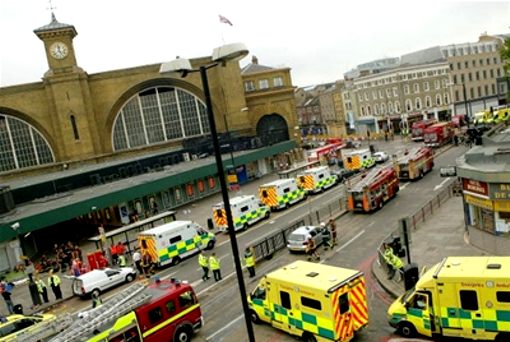 According to the time line of the emergency services responses in the first hour after the explosion and as reported by the GLA in their final report:
King's Cross
2.51 The train between King’s Cross and Russell Square was left completely isolated by the explosion. There were very few 999 calls reporting the explosion; mobile phones do not operate underground. Radio communication from the train had been disabled. Nobody on the train could communicate with the world outside without leaving and walking down the tunnel to a station platform.
2.52 The Metropolitan Police Service was first alerted to an incident at King’s Cross at 8.56 am, on the basis of CCTV footage of the station.
2.53 The London Fire Brigade received its first 999 call, reporting smoke issuing from a tunnel at King’s Cross, at 9.02 am. At 9.04 am, a ‘split attendance’ was mobilised, with three fire engines sent to Euston Square and one to King’s Cross. Fire engines arrived at Euston Square (which turned out not to be one of the sites where passengers were emerging from tunnels) at 9.07 and 9.11 am. The first fire engine arrived at King’s Cross station at 9.13 am. At 9.19 am, and again at 9.36 am, further fire engines were requested to King’s Cross. There is no information to show when these further appliances arrived.
2.54 The first 999 London Ambulance Service call reporting an incident at King’s Cross was received at 9.04 am. A London Ambulance Service Fast Response Unit arrived at King’s Cross at 9.14 am, followed by the first ambulance at 9.19 am. A major incident was declared at King’s Cross by the Metropolitan Police Service at 9.15 am and then by the London Ambulance Service at 9.21 am.
2.55 It is unclear precisely when the London Fire Brigade became aware that there had been an explosion at King’s Cross. However, we do know that the ability of the London Fire Brigade to establish what had happened at King’s Cross was hampered by the fact that hand-held radios did not work effectively between the platform and a control position at the top of the escalator, nor between the top of the escalator and outside the station. The Fire Brigade therefore had to use runners – individuals running up and down escalators – to communicate from below ground to the surface.
2.56 No Fire Rescue Unit was deployed to King’s Cross in the initial stages of the response.
2.57 Communications problems made it difficult for the emergency and transport services to establish what had happened to the passengers emerging from the tunnel at King’s Cross station.
 |
The scene outside Russell Square station, Bernard Street, Bloomsbury. The Russell Hotel is on the right of the picture.
|
Russell Square
2.58 The explosion on the Piccadilly Line train took place in the first carriage, at the Russell Square end of the train. It was via Russell Square station that the seriously injured were brought to ground level as the rescue effort got underway.
2.59 The first 999 ambulance call reporting an incident at Russell Square was not received until 9.18 am, 25 minutes after the explosion. Passengers began appearing at the platform, having been led from the train by one of the two drivers in the driver’s cab. The London Ambulance Service despatched a Fast Response Unit at 9.24 am, which arrived at Russell Square station at 9.30 am. A major incident was finally declared at Russell Square by the London Ambulance Service at 9.38 am, 45 minutes after the explosion. At that point, the Ambulance Service Professional Standards Officer at the scene was reporting 6-15 fatalities and 50+ casualties. This was a full 20 minutes after the British Transport Police received reports of loss of life and limbs.
2.60 We cannot glean from the information provided to us by the Metropolitan Police Service at what time they were aware of the incident at Russell Square, as their records treat King’s Cross and Russell Square as the same incident.
2.61 From the information provided to us by the London Fire Brigade, it would appear that no fire engines were sent to Russell Square at any point during the first hour following the explosions.
2.62 The initial deployment of ambulances and fire engines to Russell Square was much slower than at the other sites, and it took longer to establish what had happened. The first 999 call was not received until 25 minutes after the explosion, and a major incident was not declared until 9.38 am.
2.63 There was no automatic deployment of the emergency services to Russell Square upon discovery of the train at the King’s Cross end of the tunnel. Had this happened, ambulances and other emergency services personnel might have arrived at the scene earlier. The London Fire Brigade did order a ‘split attendance’, but to a station which turned out not to have been affected (Euston Square).
2.64 In the absence of the Fire Brigade at Russell Square, the task of making the scene safe for other emergency services, and evacuating the injured at Russell Square, was instead carried out by the London Underground Emergency Response Unit who, along with the two drivers, evacuated passengers from the first carriage and removed the seriously injured up to the station concourse at ground level. The Emergency Response Unit is a small and little-known unit which is responsible for responding rapidly to incidents on the Tube, such as suicides, derailments, and passenger emergencies. On 7 July the unit attended each scene and played a crucial role in the emergency response. They are experts in dealing with emergencies on and around trains, and have specialist equipment for supporting tunnels, dismantling trains, and helping to rescue people from damaged trains. The unit is regularly deployed to respond to people on the tracks, as well as other emergencies.
The Emergency Response Unit (ERU) that attended at Russell Square in the absence of the Fire Brigade, is run by Tube Lines along with the Piccadilly Line. The ERU trains with the military in how to deal with terrorist attacks. An interview with one of the ERU team on this BBC London news coverage starts at approx 05.03:
Ex Royal Greenjacket's platoon Sergeant, Joe Moore, was with his team on a training day. But they were bleeped too. They commandeered an unmarked vehicle and got to their base in Acton. There they saw News 24, and realised what was really happening.
Joe Moore and the rest of the ERU men on duty were sent to all three bomb sites, providing expert technical backup to the rescue teams. Using their heavy lifting gear, and cutting equipment – they were able to get the ambulance and fire teams in to areas the bomb damage had cut off.
Source: BBC News
Surely the Emergency Rescue Unit would not have discovered what was going on via news reports, especially given that their role, as indicated by the title of the Emergency Rescue Unit, is rescuing people from emergencies and, further, that the first news reports did not hit the airwaves until half an hour after the time of the first reported incident.
The Greater London Authority 7 July Review Committee final report states:
3.40 At Russell Square, the scene was finally cleared when the last patient was removed, almost three hours after the explosion. So far as we can tell from the limited records that were kept by the London Ambulance Service, and from the accounts we have heard from survivors of the explosion who were brought out of the tunnel to Russell Square station, the medical response relied heavily upon voluntary assistance from doctors and nurses from nearby hospitals. There was a shortage of ambulances until after 11 am, and delays in deploying the appropriate equipment, personnel, and vehicles to the scene.
3.41 The information given to us by the London Ambulance Service shows repeated instances of London Ambulance Service officers requesting more ambulances, supplies and equipment and receiving no response. The British Transport Police reported that there were at least 200 casualties at 9.18 am. A Fast Response Unit arrived at the scene 12 minutes later, at 9.30 am. At 9.38 am a London Ambulance Service Professional Standards Officer declared a major incident - reporting 50+ casualties and six to 15 fatalities - and stated that there was only one ambulance at the scene, along with the Fast Response Unit.
3.42 At 9.40 am, the Metropolitan Police Service requested the London Ambulance Service to ‘send every unit that you have got’. At 9.48 am, one ambulance was despatched from University College Hospital. At 10.02 am, a request was made for five ambulances and a bus. At 10.13 am, the manager at the scene reported that there were 40-50 walking wounded and 100 stretcher cases still in the tunnel. There was still only one ambulance on the scene at that point.
3.43 At 10.22 am an equipment vehicle was requested. At 10.27 am, the manager at the scene requested an estimated time of arrival of the ambulances that had been requested. There was no reply from Central Ambulance Control. At 10.42 am, the manager made a further report to Central Ambulance Control, and again requested an estimated time of arrival of the equipment. At 11.10 am, there were still only three ambulances at the scene, and a further ten were still needed. Finally, at 12.12 pm, the scene was clear of casualties.
3.44 The response of the London Ambulance Service at Russell Square can be partly explained by the general communications problems the service experienced across London on 7 July. These problems were exacerbated at Russell Square because of its proximity to Tavistock Square, where the bomb was detonated on the No. 30 bus. For some time after the bus explosion, ambulances destined for both sites were being directed to the same muster point on a road nearby. This was not realised until after 11am. Until that point, ambulances called to Russell Square were being diverted to Tavistock Square – a much more visible and immediately apparent emergency. Eventually, a system of runners was set up between the two scenes, and ambulances were redirected to Russell Square to take casualties to hospital.
Amongst the confusion of the day, come conflicting accounts of who precisely were the first emergency service personnel to enter the stricken carriages. According to Inspector Stephen Mingay, awarded an MBE in 2006, who approached the train from King's Cross and we can assume was one of the two policemen seen by those in the end carriages:
Inspector Stephen Mingay was the first police officer to reach the blast-hit Tube train at King's Cross underground when the bombers struck on 7 July.
He was standing at the entrance to the Piccadilly Line when he felt an explosion beneath his feet.
"I literally felt the explosion through the ground," he said after receiving an award for his "outstanding actions".
He was one of 96 British Transport Police officers praised for their rescue work after the bombings.
'Scared people'
A few moments after the blast, he saw "soot-stained" passengers making their way out.
He described seeing a "big wall of smoke" coming up from the tunnel as he ran towards the track with a colleague.
After turning back to call 999, he returned and walked along the track for 100 metres until he reached the train.
"There were a lot of scared people in the back of that train," he said. "Some people were so scared I had to lift them off the train.
"We did not know there had been simultaneous attacks, we were unaware of the other bombs going off."
'Called for quiet'
After aiding the walking wounded, he eventually reached the carriage where the bomb had detonated.
"What I saw in that carriage - no amount of training could prepare you for that," he said.
"I called for quiet and identified myself and what I was going to do for them; to go back so as I could get the specialist help they needed."
The 46-year-old said leaving the wounded to get help was one of the hardest decisions he had faced in his career.
Although it went against his instinct, he believes his actions "enabled a more co-ordinated rescue and probably saved more lives".
He was commended for evacuating "large numbers of passengers from the bomb-damaged train amidst horrific conditions".
Yet this report of Firefighter Aaron Roche claims that he was the first person to enter the carriage from King's Cross after the bomb went off, albeit carriage 346A - which cannot exist as the first carriage on a Piccadilly Line train, rather than carriage 166:
He was firefighter Aaron Roche, the first person to enter carriage 346A of the 8.51am Piccadilly Line service from King's Cross after the 7 July bombs went off ....... It had just turned 10am when Roche began striding along the dark tunnel towards the stranded train. No one had a clue what had caused its sudden breakdown. Roche had begun to fear the worst, though, as he came across a bedraggled string of passengers, their blackened, bleeding faces almost invisible in the choking clouds of smoke.
The train itself, though, seemed in better shape. Structurally, it seemed fine, its windows smashed by fire extinguishers hurled by commuters desperate to escape. Inside it was a different story. Passengers lay sprawled in each carriage, some nursing wounds, others simply too shocked to move.
At either end of 346A, bodies lay three to four feet deep. In its centre, though, the floor was clear.
On closer inspection, Roche discovered a metallic crater, the point where suicide bomber Germaine Lindsay had detonated his rucksack of explosives. 'The dust was still thick; it was hard to see to the other end of the carriage. At this stage it was difficult to gauge the number of casualties because all skin tissues were grey with dust.
'It was very dark. Slowly, I began to make out body parts - the legs and arms of people. Limbs that I couldn't tell which body they belonged to.'
At first, Roche deduced that everyone in 346A must be dead. Then he saw the elderly woman. She was yards from where the imposing frame of 19-year-old Lindsay had settled as he counted down the moments before detonating his explosives.
'She was staring back at me. I can remember the whites of her eyes so clearly because the rest of her was just covered in dust,' Roche said. Then from behind came a low moan. Roche turned disbelievingly. It was coming from beneath a mound of corpses.
'There was a sea of bodies and body parts at either end of the carriage. If you looked hard enough, you could see bodies shifting and twitching underneath piles of bodies.'
Roche called out to two colleagues who had followed him and together they began dragging off the corpses from those still breathing. In the minutes that followed, they remember hearing the soft accent of a Geordie man offering his gratitude as they freed his foot trapped from beneath a seat.
Blue Watch dragged six people alive from carriage 346A, some with miraculously minor injuries. The elderly woman sustained only a sore ankle.
The last survivor pulled from the carriage was Garri Holness from Streatham, south London, found lying on the blood-soaked floor among dead passengers. Scarred all over from the blast, Holness already knew he had lost part of his left leg.
Source: The Guardian
Interestingly, no firefighters were honoured for their part in the rescue when these were being dished out in the New Year's Honours list. British Transport Police officers Steve Bryan and Aaron Debnam whose book 'One Morning in July - The Man Who Was First on the Scene Tells His Story' - claim also to be the first emergency workers to rescue survivors from this carriage, entering the train from Russell Square. Aaron Debnam also took the last survivor from the carriage, but this time it wasn't Garri Holness, but the truly courageous and extraordinary Gill Hicks.
[...] the two British Transport Police officers, PCs Steve Bryan and Aaron Debnam, who rescued her from the wrecked station.
Why Gill in the crtitical state she was in, was not taken up in the lift, considering all the earlier walking-wounded had exited this way, is not explained.
Barely alive, she was brought from the train wreckage up the 145 emergency steps at Russell Square tube by six policemen. There were no stretchers, so they carried her in a blanket. It was stiflingly hot. "Stay with us, stay with us," they told her, as she rolled in and out of consciousness.
At street level, it was chaos - gridlock, a shortage of medical supplies and no ambulances because they had been called to bomb victims at the three other sites. She was laid out in the ticket hall where her body temperature began to drop.
Another bomb was expected and there were orders to evacuate the scene, but the nurse who was massaging her heart refused to abandon her.
A volunteer ambulance crew from the fringes of Essex did not know the way to any London hospital except St Thomas's, so that is where they took her. Her heart stopped again as they were going over Westminster Bridge. She had to be resuscitated for more than 15 minutes in A & E.
Source: The Telegraph
Why exactly 'another bomb was expected' in Gill Hicks' account is not clear. Of little importance, but for accuracy, according to Wiki there are 177 steps at Russell Square not 145 and 3 lifts:
Russell Square station has three lifts but no escalators. The platforms can also be reached by a spiral staircase with 177 steps, although signs in the station indicate that there are 175 steps.
Another 'first on the scene' was a senior paramedic, David Whitmore, who makes the point that the injured were brought up from the train in these lifts. This again demands that the question be re-asked: Why was Gill Hicks carried up so many stairs in a blanket in a critical condition if others were being brought out by lift?
David Whitmore, a senior paramedic and clinical adviser at the London Ambulance Service, was among the first emergency crews to arrive on the scene at the Russell Square end of the tunnel.
A veteran of the Victoria Station, Harrods and Hyde Park terror bombings in the 1980s and 1990s, he said the scene that greeted him this week was the worst he has ever encountered in his career.
Whitmore said those working underground over the next few days faced an "incredibly difficult task". He added: "It is a very deep station and very cramped. There was a lot of dust with people lying and sitting all over the place. People were wandering around looking utterly dazed.
"As I moved on to the platform there was a big wall of smoke just hanging in the air. It made it very difficult to find people. We had to use the lifts to bring people up.
"The train itself was totally mangled and there was extensive damage to the tunnel walls, but the integrity of the Tube has held.
"In the back of everyone's minds will be the fear of the tunnel caving in, but we just have to try not to think about it and concentrate on the job."
Garri Holness describes a woman called 'Alison' who is also referred to in the Evening Standard article which mentions carriage 346A.
"And all of a sudden I saw flashlights coming from the driver's side. The ambulance and the police came in. And they took everybody out, bit by bit. And me and Alison was the last two to leave.
Alison Macarthy, in carriage 346A with Garri, claims to have tied a tourniquet around the legs of Gill Hicks to stem the flow of blood:
Garri Holness, whose left leg was amputated below the knee, said he owes his life to Ms Macarthy, whom he calls "my guardian angel". He added: "She was full of shrapnel and yet she helped all of us. I wouldn't be alive today if it wasn't for her."
Ms Macarthy, 30, was standing two to three feet from Jermaine Lindsay when he detonated the bomb in his rucksack. The explosion tore a hole the size of a tennis ball in the back of her right knee, exposing the tendon.
But she picked herself up off the carriage floor and began tending other passengers. She took off her jacket and tied the arm tight just below Mr Holness's left knee.
Doctors have said that action alone stemmed the loss of blood and saved his life.
She then worked her way across the carriage to Gill Hicks, 37, who had lost both legs.
Ms Macarthy took the woman's scarf and used it as a tourniquet.
Ms Hicks had lost 75 per cent of her blood and her heart stopped twice on the way to hospital.
Ms Macarthy's actions almost certainly saved her life as well. She returned to Mr Holness, who by now was slumped in a seat, and kept him from slipping out of consciousness.
Yet Gill seems very certain that she tied her scarf around her legs herself and she makes no mention of Alison Macarthy in any of her accounts of that day:
It was, it, apart from this being a normal day, it was sort of once again abnormal in the sense that I was wearing a scarf and I don't normally wear scarves, and I'm certainly counting my blessings that I had a scarf on that morning, and so I took my scarf off and it was a sort of chiffony material, which is quite hard to tear actually.
So I was sort of sitting there on this bench seat, and of course all this feels like it's happening in a very long period of time, but it must sort of be minutes that you're reacting in this way, and I ripped my scarf in half and applied almost, well, tied them as tourniquets around both legs to try and make some attempt at stopping the amount of blood that I was losing.
By 11.00 Garri is in transit to the Royal Free Hospital whereas Gill is still being rescued, after which she is taken to St Thomas Hospital, a 2.5 mile journey across a grid locked London.
This account has Glenn McMunn, also awarded an MBE in 2006, of the BTP being one of the first on to the train where Gill is rescued, but there is no mention of Garri in his report, nor of the fireman that Gary Stevens claimed was the first person to arrive at the train:
Arriving at Russell Square, he found a couple of dozen soot-coated people in the small area in front of and behind the barriers. Down at the Piccadilly Line platform, he came across the driver, clearly distressed, who explained that a bomb had gone off on his train and that there were still many severely injured people on board. With McMunn, by this time, were two transport police, several Metropolitan officers and four paramedics. Would they, he asked, be happy to go down the tunnel and see what they could do to help?
McMunn recalls approaching the train.
With the power shut down, they had to use torches to illuminate the three quarters-of-a-mile walk down the tunnel.
The smoke thickened into a fog as they got closer, making it difficult to breathe.
"It was quite eerie and there was one gentleman on the left hand side of the train who had had half his leg blown off.
A paramedic attended to him and I went onto the train with the other three paramedics and one officer. In my own mind I had thought, 'Right, I'm just going to go on with the paramedics.' I didn't want the other officers on because I wanted to assess the situation first just in case there might be secondary devices and I just wanted to see what this bomb had done to the integrity of the tunnel. Would it be safe under there?"
Inside, in the dark, he almost tripped over one man. "I wasn't sure whether he was alive or dead although he turned out to be alive." There was a huge ragged hole in the top of the train and the doors had been buckled and virtually blown out and bodies were piled on top of each other.
Is it possible that Gill Hicks was the last survivor to be evacuated from a different train to Garri Holness? Whether there were more explosions than are admitted in the official version is examined extensively in the London Bombings Dossier compiled by David Minahan.
Steve Mingay and Aaron Roche both claimed to be the first to enter the stricken carriage from King's Cross, yet Inspector Ray Shields of the BTP also makes this claim:
For the emergency services, the work was only beginning. For veteran police Inspector Ray Shields the mayhem was all too familiar. He had travelled early down to King's Cross from his home in Peterborough, Cambridgeshire. He had also been there in 1987, when the fire in the underground concourse killed 31 commuters. Now, 18 years on, as a senior British Transport Inspector, horror was unravelling once again.
Shields and his fellow officers dashed down to the track the moment the explosion was heard and began trying to haul out the passengers trapped within the tunnel. The scene was chaotic. Only passengers on the King's Cross side of the blast could be hauled out: the vast majority were trapped behind the blast site which had blocked the tunnel entirely. The police on the King's Cross side saw the worst of the damage. Sergeant Steve Betts, one of the British Transport police officers first to reach the scene, gave a harrowing account of the mayhem.
"I am not very good at enclosed spaces at the best of times and we had to climb over bodies and body parts to try and help people. I found a man and his leg had been blown off below the knee. There was another body next to him. There was also what I thought was a pile of clothes but as I passed to try and get to the man, it moaned and asked me for help. It was a woman. She had all her limbs blown off. I think she died on the concourse," he said. Human endurance was being tested to the limit.
The description of the police on the King's Cross side of the tunnel seeing the worst of the damage is a bizarre statement, considering that the mass of casualties were in the Russell Square end of the train. Another of the first people into the carriage is Sergeant Steve Betts:
At King's Cross, the torches of transport police probe the smoky darkness. The train is 150 metres out of the station, around a corner in a deep and very tight tunnel. As the first rescuers approach, a few walking wounded stagger towards them. Sergeant Steve Betts hears somebody cry out for help, but he can't see who. He calls out, but there is no response. There is only about six inches of space on either side of the train, so the force of the blast has been contained and pushed back on to the passengers. Inside the first carriage, Betts sees "people with limbs missing, huge open wounds with their organs showing" and he hears people "crying out and moaning and asking for help". It's like the end of the world, he thinks. But then he thinks, "Do your job". He climbs over dead bodies, trying to work out who is still alive, and finds a man who has lost his leg below the knee. To reach him, the policeman has to get past a pile of clothes. As he tries to do that, the pile of clothes moans for help. It is a woman. All her limbs had been blown off.
It was, he says, as though someone had poured black paint over shop dummies, cut them up and filled the train with their parts. The woman he found who lost all her limbs has died on the station concourse.
This report also contradicts Aaron Roche as being the first person into the train from King's Cross unless of course there was more than one train or some of these reports are descriptions of a 'live exercise' that day, and is the only report that doesn't describe the thick black smoke:
A divisional commander with London Fire Brigade, he was at King's Cross when the first bomb went off and climbed down into the tunnel to help bring out the 21 bodies.
'The effect of a blast is like a thunder clap or a very loud firework and that can numb your thoughts for a while. We knew that the difficulty we were going to have was managing people and getting them to the surface. Getting people out of the train was difficult, it was a matter of getting them out by hand or torchlight but it was difficult to even see them: there wasn't smoke as such but a very, very fine dust which really reduced visibility.
'It was pretty chaotic at first, as you would expect. There were blast injuries and a lot of people were traumatised.
1500 Metropolitan Police and 75 British Transport Police officers were in Scotland policing the G8 on 7th July, which might account for the use of trainee police officers at the scene in Russell Square. They tell of thick smoke rather than the fine dust described by Terence Adams:
A TEAM of rookie Camden police officers were among those commended this week for bravery during the July 7 bombings. The seven trainee police constables had been working just five weeks when they were called to pull passengers from the wreckage of the Piccadilly Line train.
After getting the call at Hampstead police station, officers fought through thick smoke and the fear of a secondary bomb explosion to tend to the injured at Russell Square Station.
PC Claire Moffet, 24, said: "We had started hearing reports of smoke coming out from King's Cross and we were told by our sergeant, Neil Drinkwater, to put on our high visibility jackets. "We drove as fast as we could down to King's Cross. I thought we were going to die before we got there we were going so quick."
PC Phillippa Mason said: "We went down into the tunnel at Russell Square to find the train. There was smoke everywhere and none of the lighting was working. "We came across injured people lying on the platform and the train itself was obliterated." The team battled for three hours in the tunnel helping passengers to safety and comforting those that they could not move.
Source: Hampstead & Highgate Express
Removal and identification of the victims
From the UK Resilience website Guidance on dealing with fatalities in an Emergency (PDF):
Victim Recovery
3.11 The recovery of the dead and human remains is also an evidence recovery process. It is normally appropriate for trained police officers to carry out this task. A number of police forces throughout the United Kingdom have such trained teams. However, in some incidents it may be necessary to seek wider support, for example from the military and this should be considered and agreed as part of the planning process.3.12 Recovery will be conducted under the overall supervision of the scene evidence recovery manager and carried out as part of a carefully documented process. This process will normally use nationally recognised victim labels and recovery booklets each bearing a unique reference number. In addition to contemporaneous documentation the process may be supported by video and still photography. There is no specific definition of what constitutes a body (under section 8 of the Coroners Act 1988), essentially the test will be whether the quantity of remains found is sufficient enough to prove death.
Naturally there is a major difference between dealing with an accident site and a crime scene, and there are no reports of the victims being photographed in situ or how evidence was gathered before the victims were removed from the carriage, Andy Hayman had claimed on 8th July that the Metropolitan Police forensics team had yet to gain access to the carriage.
Those identifying victims of a mass killing must first study the bodies at the crime scene. They are photographed and checked to see if there are clues near by, such as weapons. The way in which a body has been damaged, the path taken by flying limbs or the site of burns or scorch marks, can all give clues to the location of a bomb.
Source: The Times
How on earth the proximity to the explosion was established, either for the alleged perpetrator, Lindsay, or the victims is very unclear, especially when considering this report (unfortunately vanished down the memory hole) from some of the first responders on the 7th:
You're looking and you can't believe it," says Jackson. "You're shocked, then the adrenaline kicks in and you do your job. You just blank it out."
Jackson called for more lighting and more fire fighters arrived. "We had to get dead people out of the way so we could get to people trapped underneath.
We were taking bodies out of the carriage, but eventually we just piled them to the side of the carriage."
There were dismembered parts everywhere.
It was impossible to tell which had come from which bodies. "The floor was really slippery, you didn't know what you were stepping on," says Collins, 29. The firefighters didn't know if a dirty bomb had gone off, or if another device would explode. They worked on in the heat and stench, soaked in sweat and parched. A triage was set up and paramedics tagged people - from 0 (dead) to 4 (minor injuries).
Source: Cached copy only
Detective Inspector Jim Dickie had responsibility for the identification of the victims and had this to say at a press conference on 9th July:
... the recovery of bodies and identification of those who had died was both complex and harrowing. Many people had suffered extensive injuries and it could take longer [to] formally identify these victims.
Many reports were describing that as many as 20 bodies were still trapped within the train on 10th July, although the death toll of 21, just 6 less than the final number for the Piccadilly line had been reported by the MPS on the 7th:
The conditions were grim with an almost unbearable stench in 140F heat. Twenty bodies are believed to be still trapped in the wreckage of the Piccadilly Line train 150ft below ground and it is expected to be days before they are all recovered.
Yesterday as some bodies were brought to the surface the air was filled with the chilling sound of mobile phones ringing. Handsets in the victims' pockets had been unable to receive a signal since the attack as they lay in the Tube tunnel.
Deputy Chief Constable Andy Trotter, of British Transport Police, said last night: "It's very tight at the point of the incident. The confined space made the devastation even more horrific. It is extremely hot. When the rescue teams were recovering live people, they overcame the difficulties. But we have had to stop and regroup.
"We don't know how many bodies are left in the carriage at the moment. It is very hot, dusty and dangerous. But we are continuing to recover bodies and they are being removed to the mortuary."
He added: "We are aware of the anguish of the relatives and our hearts go out to them."
A police source said: "The mobile phones started ringing as soon as the bodies reached the surface. It is very distressing to hear the ringing sounds from simply hundreds of messages on the voicemails of phones belonging to the dead. It just made the crews realise how many people are still clinging to the belief that people caught up in the explosions are still alive. It brought tears to the eyes of some.
"Sadly the officers couldn't touch the phones because it's a crime scene. They weren't even able to let the people who made the calls know the truth."
At least 21 people died after the second of four bombs exploded at 8.56am on a Piccadilly Line train travelling from King's Cross to Russell Square. The blast caused the most devastation of three attacks on the underground because it happened so far below the surface.
The deep tunnels caused the most problems for crews attempting to reach the injured. The death toll is rising as teams work around the clock to clear the partly collapsed tunnel of bodies. The grim task which began on Friday will last into next week.
Source: The Mirror, 10th July 2005
But the forensics work is hampered by the grim conditions in the Piccadilly underground system, located 500 metres from King's Cross. The tunnel near Russell Square in London's Bloomsbury district remains unsafe in the immediate area around the blast. Engineers are concerned that the crucial steel lining that strengthens the tunnel, which has been bored through clay, may have been ruptured in the blast. They are currently considering a plan to drag several carriages down the track to obtain access to the wrecked first carriage in the train where the bomb went off. It is believed that more than 20 bodies are still trapped in the wreckage.
A specialist team of senior police officers, coroners and medical experts is now trying to ensure that the bodies are correctly identified.
Source: The Observer, 10th July 2005
An analysis of the concerns regarding the identification of victims and mix-ups over which site they came from and the use of two Bloomsbury hotels as 'body holding areas' prior to the erection of the Resilience Mortuary are included on the J7 Edgware Road Incident Analysis.
Despite the Piccadilly Line carriage being the most difficult of the scenes to reach as described in the previous two reports, the first formal identification of any of the victims and the first person to be named, occurred on 11th July and was from this train:
Susan Levy, 53, was named as a victim of the London bomb attack today - the first person to be formally identified by police. Up to 70 people may have been killed by the four bombs.
.... she was travelling on the Piccadilly Line on Thursday morning.
The significance of this first announcement of a victim's name was not lost on some of the Jewish community:
“In my mind,” he continued, “I saw all the images of Israeli buses blown up and thought, ‘It is now here. The barbarians are now at our gates.’”
With most of the United Kingdom’s 290,000 Jews living in London, it was with a sense of inevitability that the community awaited details of possible Jewish casualties, as missing commuters were listed and fatality totals were announced. More than 50 people are known to have died and the number of deaths is expected to rise.
The first Jewish death officially confirmed was Susan Levy, 53, a mother of two from Hertfordshire, who was killed on her way to work in the subway train explosion near King’s Cross.
That many of the victims still had working mobile phones on them, according to the police source quoted in the Mirror, is astounding and surely should have prevented many of the families and loved ones spending many long agonising days awaiting news, forced to resort to posting photos of the missing around King's Cross in scenes reminiscent of those around the WTCs on 11th September 2001.
 |
|
Pictured: Christian Njoya Small – who Daniel Obachike claims to have seen alive after the Piccadilly Line explosion |
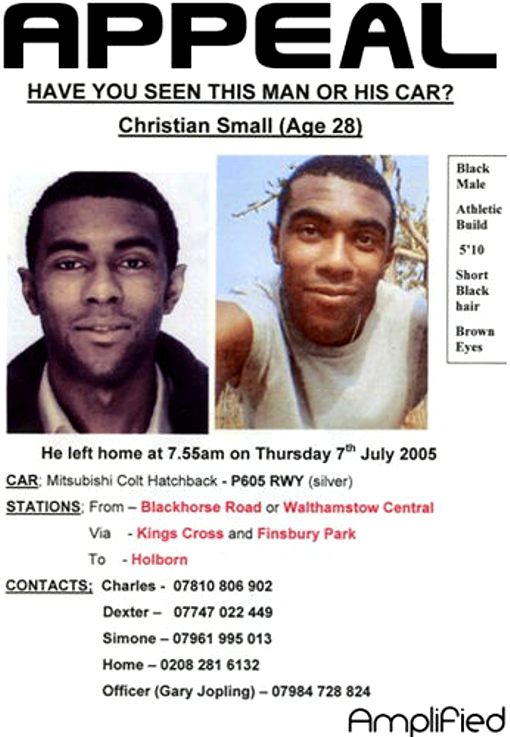
Many and varied reports of the tunnel having collapsed onto the train and track due to the explosion and the fears of further tunnel collapse hampering the investigation, were a feature of the news from this incident:
The force of the blast in the confined space caused large sections of the walls to collapse inwards on to the carriages and tracks.
Yet strangely, no mention is made of damage to the tunnel in a Tube Lines report on the 3rd August 2005 when repairs were completed:
Back in business – Tube Lines completes repairs on Piccadilly line after bomb
The first task was to thoroughly clean the area and then experts checked the tunnel, track, cables and signalling equipment for damage. This assessment revealed damage to track components and cables carrying signalling information, communications and power. Parts of the track were replaced and extensive repairs carried out to cables and signals.
To ensure operational safety, rigorous tests were completed on all systems, including ultrasonic inspections of the track. These culminated in dynamic testing using a battery powered locomotive on Tuesday 2 August. The line was then formally handed back to London Underground’s line controllers.
It would be interesting to know whether these simulations have been carried out and what the results were:
Meanwhile experts at Qinetiq, the government's former research agency, are to begin creating computer simulations that will show the locations of where the bombs were planted and the directions of the blast.
Although it may be prudent to acknowledge that if these simulations were ever to be shown, the infamous Carlyle private equity group have a 33% stake in Qinetiq.
The Casualty Bureau fiasco
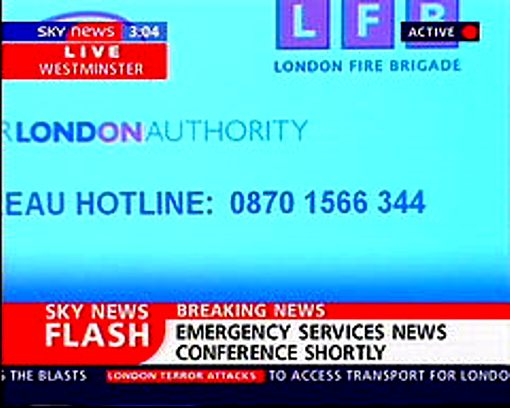 Another of the odd and somewhat unfathomable aspects of July 7th 2005, and distinctly noticeable by anyone watching the rolling news coverage, or listening to the radio reports -- including interviews with Sir Ian Blair as late as 12.30 -- was the total lack of information given about how to check whether loved ones were amongst the casualties. The question was never posed by any of the interviewers or mentioned in any reports. In comparison with news from any major disaster or accident where a telephone number is immediately made available to phone for information, on the morning of July 7th this failed to happen. Considering the conflicting information issued by the Metropolitan Police Service and TfL about the direction of the trains and the locations of the explosions, the need for a single, centralised point of contact was crucial. The first police announcement of a Casualty Bureau number was at the press conference held at 15.30 and in this press release issued at 16.30. An issue not lost on the press the next day:
There were also questions about the length of time it took the police to set up a central casualty bureau with a dedicated hotline so that accurate information could be given to friends and relatives of victims.
There are London Response guidelines on setting up a casualty bureau. Ron McPherson, Deputy Assistant Commissioner, Metropolitan Police Service, in his testimony to the GLA Review Committee explained the setting up of the casualty bureau and the reasons for the delay:
The MPS Casualty Bureau came online with another 34 call-takers at around 3.40pm or 4pm that afternoon, so it was later than we would have liked. The reason for that was that there was a line fault somewherse between the British Telecom (BT) exchange through Damovo, our outsourced telephony supplier, and the Casualty Bureau switch at Hendon. When that fault was finally identified and fixed, we were then back on line.
In the second hour of the incident, when the Casualty Bureau lines were announced, there were over 43,000 calls made to that national facility. There is an agreed commercial formula called Erlane which shows you that if you know how many calls you have and know how long they take, you know how many operators you need. To answer 43,000 calls would have needed 2,500 operators. That is not a sustainable position for any emergency service to take forward.
Over the course of that day, over 190,000* calls were presented to the telephony network. Once we had opened, we took over 1,000 calls just to the MPS on the Casualty Bureau line. There are some key issues around that. Each call takes on average between 7-12 minutes. The reason it takes that long, as was the point made earlier by my colleague, is that this is not a call centre where we are dealing with quantity, this is an incoming call where we need to extract very definite information from a person who is often traumatised and very bereaved at what may or may not have happened.
As was also said earlier, the role and function of the Casualty Bureau is to hand over to our colleagues on the detective side, accurate and relevant information that can be used later for two key issues: one is to ensure that the enquiring family knows whether that particular individual, that particular loved one, is or is not dead or alive, to try to help them as to the location of that body and where it is likely to be; and, just as importantly, to make sure that any subsequent investigation has accurate data to enable the investigation to go ahead successfully through the prosecution system.
In the whole of the incident, the Casualty Bureau ran for about 18 - 19 days in totality, but most of those phone calls were received on the first day.
Source: p34 7 July Review Committee
3 November 2005: Transcript of Item 4: 7 July – Lessons Learned (PDF)
The experiences of many that day are articulated to the GLA Review Committee by Joe, partner of Gill Hicks:
In terms of my own experience, as somebody implicated but away from the emergency scenes themselves, and in terms of the technical remit of this inquiry – the issue of communications – the thing that caused me absolutely unnecessary extra anguish and grief on the day, and I think many other people, was something that to me is incomprehensible and inexcusable, and that is the failure of the Central Casualty Bureau emergency number. This after all is one part of the emergency plan that was not theoretical; it had been tested many times under other circumstances.
Telephone systems that require heavy usage are in use all the time. The new Wembley Stadium will sell out within seconds when tickets go on supply. There are websites that take on million hits in a very short space of time.
My experience of sitting at home doing what everybody else, I imagine, did – watching BBC News 24 – is that we waited and waited and waited for means to receive information. Of course, it was impossible to call anyone by mobile phone. Eventually, the emergency number was issued on the BBC, and I started to ring it and, like everybody else, failed to get through. At the first major press conference that afternoon, at which the (Metropolitan Police) Commissioner and the heads of the LAS and the LFB were speaking, the Commissioner mentioned that there was a technical fault on the line. That was the first and last time that anyone made any reference to a problem.
[...] It took me slightly more than three hours, if my memory is correct, to register my wife as somebody who was missing and presumably involved. That needs to beaddressed. It really really really does need to be addressed.
Source: 7 July Review Commitee Minutes, 23rd March 2006 [PDF]
Considering that the Casualty Bureau number was not up and running until 16.30, Joe wouldn't have been able to register his partner's details until 20.30, over 12 hours after the event, something which he rightly says was responsible for 'causing unnecessary anguish and grief'. The experience Joe describes would have been experienced by hundreds of other people looking for news about their colleagues and loved ones.
The lack of a casualty bureau number was picked up on by Peter Power who was running the Visor Consultant's exercise that morning in precisely the same stations that the explosions occurred in, when he makes a point of stating 'and the first thing is get that bureau number...' and then again on the anniversary of 7/7 he points out that the setting up of a 'casualty bureau was extremely slow '. Both videos can be viewed here.
Not only was there little attention paid to those who were concerned for loved ones that morning, but when the casualty bureau number was finally released it was a premium rate number, which again showed a similar lack of care towards the general public. If you wanted to find out information about friends or relatives you were going to have to pay a premium rate to do so, and relatives of anyone in London at the time from overseas had no chance of contacting an official helpline of any sort until some considerable time later, specifically because 0870 numbers cannot be dialled from abroad. Given that London is one of the multicultural capitals of the world and a highly popular tourist destination in July and the magnitude of events on 7th July 2005, every facet of the initial casualty bureau number is utterly incomprehensible.
There was an outcry after the July 7 bombings in London last year when the casualty information line supplied by Cable & Wireless to the government-funded Police Information and Technology Organisation was an 0870 number.
In the three days after the attacks more than 100,000 people called in and were charged up to 10p a minute from a landline and up to 40p from a mobile. People abroad were unable to get through at all.
The Government has since ordered that any future casualty information bureau should be on 0800 lines with a separate 0207 number for callers from abroad.
‘HELPFUL’ NUMBERS RAKE IN £1.5BN A YEAR
* The Home Office uses 0870 numbers, as do the Passport Agency, Criminal Records Bureau and Work Permits UK, the Foreign Office, the DVLA, the Environment Agency, Land Registry, Ucas, Sure Start and Teacher Training Agency
Source: The Times
The Home Office report makes these claims about the casualty bureau in relation to the identification of Hasib Hussain, accused of the explosion on the number 30 bus:
7 July 22.19 Amongst the many thousands of calls to the emergency Casualty Bureau, record of a call to the police emergency hotline from Hasib Hussain’s family, reporting him missing.
10 July Driving licence and other identifying documents in the name of Hussain found at Tavistock Square. Link made between these and the missing person report.
Compare the identification of Hasib Hussain via the casualty bureau, and the identification of Susan Levy as early as the 11th July, with this heartbreaking experience of the family of young couple, Lee Harris and Samantha Badham, who died in this incident:
Letter from parents of passenger killed on King’s Cross/Russell Square train
Dear Janet (Hughes, Senior Scrutiny Manager)
With reference to our phone conversation, my questions are as follows:
1. Why was the phone helpline on a premium rate, and there were no information updates from the helpline. Whenever we phoned the helpline, we were told they would get in touch. They never did.
2. Sammy was found alive and gave her name, Samantha ______, to her rescuer, and he then passed her on to the emergency staff in the ticket hall of Russell Square, where she died.
3. When we were phoning every hospital in London, it came to one and we asked if there was a Mr Lee ______ or a Samantha ______ and they said there was a Miss Samantha ______ and they would find out more details for us. When she came back she said she was mistaken. If a person is found alive there needs to be a way of transferring their name with the person, ie: plaster, pen, anything. As this mistake built up our hopes so much.
4. It then took until 16 July to be notified of her identification.
5. We were never asked if we could or would like to see her or be with her.
6. We do not know where her body was kept. Was it in every way being looked after humanly and with respect?
7. We came to London because Lee had been identified and was in intensive care at the London Royal, and we were able to stay at their hostel. But Sammy’s sister, her only living relative, had nowhere. It was only that Lee’s boss got a hotel for us that they then had. So there was nowhere for people to go.
We thank you very much for letting us view our questions and thank you for your kindness.
Yours sincerely,
Mr B R and Mrs L J ______.Source: p223 Report of the 7 July Review Committee
Volume 3: Views and information from individuals (PDF)
Images of the Piccadilly Line train
 |
The scene of destruction inside the first carriage looking towards the 2nd carriage, cabling can clearly be seen undamaged along the tunnel wall and there is little evidence of tunnel damage. Note that the blast appears to have affected electrical areas of the train, the lighting strips, advertising boards and central lights. |
Images of the inside of all the damaged trains were released only via ABC news and not the MPS or the BBC, much to the anger of Sir Ian Blair.
Germaine Lindsay identified
On the 12th July the MPS released the following information:
By Tuesday, the investigation had led the MPS to have concerns about the movements and activities of four men, three of whom came from the West Yorkshire area. We are trying to establish their movements in the run up to last week's attacks, and specifically to establish if they all died in the explosions. Three of the search warrants were executed at home addresses of these three men.
CCTV footage showed the four men, each carrying a rucksack, at King's Cross station shortly before 08.30 on the morning of July 7. One of the men who set out from West Yorkshire was reported missing by his family to the Casualty Bureau shortly after 22.00 on July 7. We have established that he was joined on his journey to London by three other men.
Personal documents bearing the names of three of those four men have been found, close to the seats of three of the explosions:
Property belonging to the man reported missing was found on the Route 30 bus in Tavistock Square.
Property in the name of a second man was found at the scene of the Aldgate bomb. Property in the name of a third man was found at the scene of both the Aldgate and the Edgware Road bombs.
We have very strong forensic and other evidence that one of the men died in the explosion at Aldgate. This is subject to formal confirmation by the Coroner.
Despite Tanweer and Hussain being identified by the14th July, Lindsay's name is not released until the 16th:
After continued forensic work we now believe we have identified the four men who travelled from Luton and were later seen on CCTV at King's Cross shortly before 8:30am on Thursday 7th July.
We can also now confirm the identity of a fourth man who arrived in London with the three men from West Yorkshire and then died in the explosion between King's Cross and Russell Square underground stations. He was Germaine Lindsay, aged 19. We believe that he was responsible for carrying out that attack.
Before Lindsay was named, newspaper reports were carrying stories of a very different suspect in connection to this explosion. It was not until after Samantha Lewthwaite contacted the police on 13th July to report her husband missing and a subsequent police search carried out on her home, that Lindsay's property is reportedly found at the scene and his name is given to the press:
13 July Jermaine Lindsay’s wife informs police that he is missing.
Police search Lindsay’s home in Aylesbury.15 July Property belonging to Lindsay found at Russell Square.
16 July The police publicly confirm the names of Khan and Lindsay.
Source: p11 Report of the Official Account of the Bombings in London
The Home Office report claims that on the 12th July police were aware of two cars at Luton via an eye-witness report, which is how the journey from Luton to King's Cross was apparently discovered. A controlled explosion is carried out on one of the cars and it's claimed that the red Fiat Brava, towed away through lack of a parking ticket, was registered to Lindsay and being sought from an earlier aggravated burglary in which a hand-gun had been used. Yet Lindsay is not identified on the 12th July:
12 July By lunchtime, police working on the theory that there is a King’s Cross link to the 3 train bombs, all being broadly equidistant from there at the time of the explosions, identify a CCTV image of 4 men with rucksacks at King’s Cross. They recognise Tanweer first from a DVLA photograph.
The police identify CCTV images of the same 4 at Luton Station. The Micra is found at Luton and examined. 9 controlled explosions were carried out on material found in it. The Brava, which had been towed away because it did not have a parking ticket is later traced to Lindsay. There had been a report on the Police National Computer that the Brava may have been used in an aggravated burglary (see paragraph 69) and Lindsay was named as the registered keeper for the car.
The Home Office report also claims that CCTV of Lindsay arriving in Luton Station car park exists, which again was not used to identify Lindsay on the 12th neither have any of these images ever been released:
73. The next that is known of Khan, Tanweer and Hussain is the CCTV image of the Nissan Micra leaving Leeds on the morning of 7 July; and of Lindsay, the CCTV image of the Fiat Brava arriving at Luton Station car park an hour or so later.
As newspapers reported on 15th July 2005:
Alone among European media outlets, Libération identified Germaine as the fourth bomber yesterday morning. At that time, most British newspapers and even many police officers believed the fourth bomber to have been another Leeds man of Asian origin.
Germaine's identity was only established yesterday afternoon after forensic experts matched DNA samples from a house in Aylesbury, Buckinghamshire, to shreds of tissue retrieved from the Piccadilly Line train that exploded near Russell Square.
The Home Office report claims that he was identified on 15th July by property found at the scene.
A summary of unanswered questions, inconsistencies & anomalies
These are just some of the questions from King's Cross/Russell Square that any legitimate and truly independent public inquiry, one held outside of the Inquiries Act 2005, should address. There are of course many more:
- Why was the direction of this train initially reported as travelling towards King's Cross, why did this story change and what led to the story being changed?
- Why was there such a long delay before the explosion on this train was announced by the media, especially given as this incident suffered more than double the number of casualties than any of the other sites?
- Why was the train identified as Piccadilly Line train 311, then later changed to 331, despite the train driver, the Duty Operations Manager log and the station managers all identifying this train as 311?
- Why did the MPS claim to have no record of Tom Nairn the driver of Piccadilly Line train 311?
- Why was this explosion identified as occurring by the first set of carriage doors and only changed on the BBC website after a survivor told them this information was erroneous?
- Why does the MPS website still identify this explosion as having occurred by the first set of double doors?
- What was the reason for the long delay in setting up a casualty bureau and why no mention of what people should do to try and contact their loved ones by either Sir Ian Blair or TV interviewers and reporters?
- How did survivors from this explosion manage to get to BTP HQ's in Tavistock Square by 9.09. Who were these survivors?
- Why are injured survivors of this train shown on TV News walking towards back towards Russell Square and then being asked to 'return to the hotel'?
- How was Germaine Lindsay's property found at the scene only after his wife had reported him missing and her home searched by police?
- Why was Lindsay not identified on 12th July, via his car registration from CCTV at Luton station car park, which the Home Office report refers to, especially as his car is reported as being on a police database, or from his DVLA picture matched to the image at King's Cross which police claim identified Tanweer?
- Can Lindsay's property being found at the scene of the King's Cross / Russell Square blast really be taken seriously given that it was found two days AFTER police had raided his home?
- How did Germaine Lindsay manage to place a large rucksack on the floor of the train and detonate it manually if the train was at crush capacity?
- Why are there no eye-witness accounts of sighting Lindsay on the platform or on this train
- Why are there no CCTV images of Lindsay in London at all that morning?
- Why are all 4 explosions described as occurring on or near the floor which contradicts the alleged favoured method of suicide-bombers of explosives strapped to the body not carried in rucksacks?
- Which train did carriage 346A belong to?
- Why does the Home Office report fail to examine whether timing devices were constructed or used?
- Why do the GLA claim this explosion occurred at 8.53, 3 minutes after the tunnel telephone tripped?
- How were both Gill Hicks and Garri Holness 'the last survivor to be rescued' from the same train?
- How did the two women interviewed leave this train within 3 to 4 minutes?
- How did Ian and Evelyn Wade leave the 2nd carriage within 15 minutes?
- How was a forensic investigation of the scene carried out after the bodies were 'piled onto the side of the tracks'?
- Why have neither the explosives used or the method of detonation been officially stated?


